

Mystery Calling: How It Helps Your Business and How to Run It (2026 Update)

For many customers, the phone call is still the moment of truth. It is where they go when a website cannot answer their question, when something has gone wrong, or when a decision is too important to make online. Yet most businesses have little idea what actually happens on those calls. Mystery calling shows you exactly what happens in that moment, before it costs you a customer.
Mystery calling closes that gap. This guide explains what mystery calling is, who uses it, what to evaluate, how to run a program step by step, and how call recording and AI have made it faster and more reliable.
What is mystery calling?
Mystery calling is a research method in which a trained caller contacts a business posing as a real customer, follows a prepared scenario, and evaluates the service they receive against agreed criteria. It is the phone-based form of mystery shopping.
Because the employee does not know the call is an evaluation, mystery calling shows the experience real customers get: how long they wait, how they are greeted, whether their question is answered correctly, and whether they are left with a good impression of the brand.
Mystery calling vs call monitoring vs customer surveys
Mystery calling is often confused with other ways of measuring phone service. Each answers a different question, and the strongest programs combine them.
| Mystery calling | Internal call monitoring | Post-call customer survey | |
|---|---|---|---|
| Who evaluates | Trained independent caller | Team leader or QA specialist | The real customer |
| What it measures | Service against a defined standard | Agent compliance with scripts and processes | Customer satisfaction and perception |
| Controlled scenario | Yes, the same situation can be tested everywhere | No, depends on the calls that come in | No |
| Covers third parties and competitors | Yes | No, only your own recorded calls | No |
| Covers calls that are never answered | Yes, waits and missed calls are measured | Usually not | No, unanswered callers cannot be surveyed |
| Main limitation | Sample of calls, not every call | Reviewer may not be objective | Low response rates, responses skew to extremes |
The controlled scenario is what makes mystery calling unique: because every location receives the same question in the same way, results can be compared fairly.
Who uses mystery calling?
Any business that sells, books or supports customers by phone can benefit, but it is especially valuable where calls are frequent, staff are numerous or the stakes of each call are high.
| Industry | Typical focus of the calls |
|---|---|
| Banking and insurance | Product explanations, compliance with required disclosures, complaint handling |
| Telecom and utilities | Plan advice, retention when customers ask to cancel, technical support |
| Automotive | Lead handling for test drives and service bookings, follow-up |
| Hotels and travel | Reservations, upselling, handling special requests |
| Healthcare and clinics | Appointment booking, waiting times, empathy and privacy |
| Retail and e-commerce | Stock and order queries, returns, store information |
| Real estate | Response to property enquiries, viewing arrangements |
| Public sector | Accuracy and consistency of information given to citizens |
Mystery calling is equally useful for evaluating your own contact center, a third-party call center you outsource to, a dealer or franchise network, or, as a benchmark, your competitors.
What can be evaluated on a mystery call?
A good mystery call follows the customer’s journey from the moment they dial to the moment they hang up, with evaluation points at every stage.
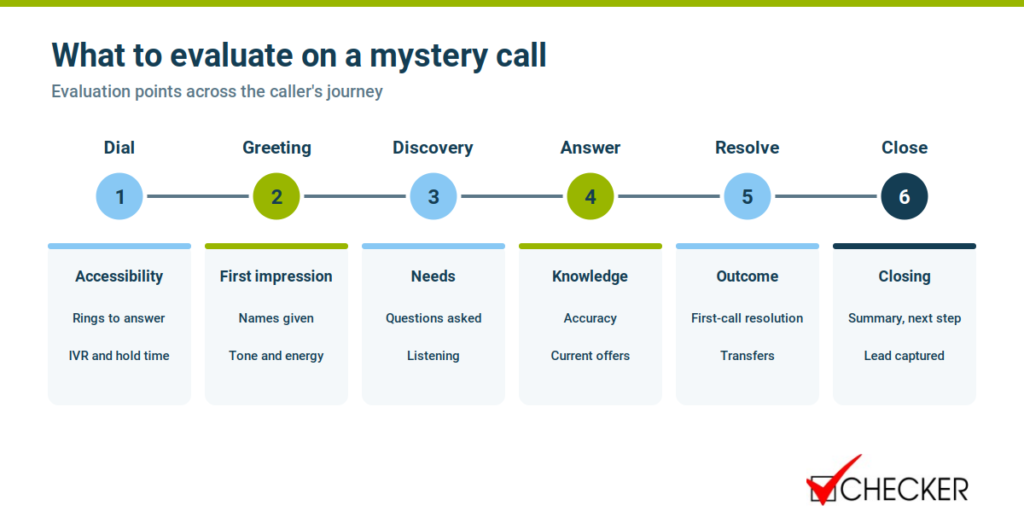
Accessibility and waiting time. How many rings before the call was answered? How long was the caller in the IVR menu or on hold? Was there a callback option? Long waits are one of the most common customer complaints and are easy to measure objectively.
Greeting and first impression. Did the employee give the company name and their own name? Did they sound engaged, and did they use the agreed greeting?
Needs discovery. Did the employee ask questions to understand the caller’s situation before offering a solution, or jump straight to a script?
Product, service and policy knowledge. Were answers accurate and complete? Did the employee know current offers, prices and conditions? Accuracy is one of the most valuable things to check, because a wrong answer can cost a sale or create a complaint later.
Problem resolution. Was the caller’s issue resolved on the first call? If not, was there a clear next step?
Communication and empathy. Was the employee polite, patient and clear, including with a frustrated or confused caller? Did the tone match the brand?
Transfers and holds. If the call was transferred, was it to the right person, quickly, and with an explanation? Did the caller have to repeat themselves?
Sales and closing. Did the employee recommend a relevant product, try to book an appointment or capture contact details? Did they summarize and close the call properly?
Compliance. Were required disclosures, data protection checks or script elements included?
Example questions by industry
The core criteria stay the same, but the questions that matter most change from sector to sector.
Banking and insurance
- Did the employee explain the key costs and conditions of the product (fees, interest rate, excess)?
- Were required risk warnings or disclosures given?
- Did the employee verify identity before discussing account details?
- Did they avoid pressuring the caller into a decision?
Automotive dealerships
- Was a test drive or showroom visit offered?
- Did the salesperson ask for the caller’s name, phone number and email?
- Was a follow-up call or email received within the promised time?
- Did the employee know current finance and trade-in offers?
Hotels and travel
- Were room types, rates and cancellation conditions explained clearly?
- Was an upgrade, breakfast or other extra offered?
- Was a special request (late arrival, accessibility, dietary needs) handled confidently?
- Did the employee confirm the booking details at the end?
Healthcare and clinics
- How long until the first available appointment was offered?
- Did the employee show empathy and avoid medical jargon?
- Was the caller’s personal information handled discreetly?
- Were preparation instructions for the visit given?
Telecom and utilities
- When the caller asked to cancel, did the employee ask why and present a relevant retention offer?
- Were contract terms, notice periods and fees explained accurately?
- Was a technical issue diagnosed with clear steps?
Real estate
- Was the enquiry answered or returned the same day?
- Did the agent qualify the caller’s budget, timing and requirements?
- Was a viewing proposed?
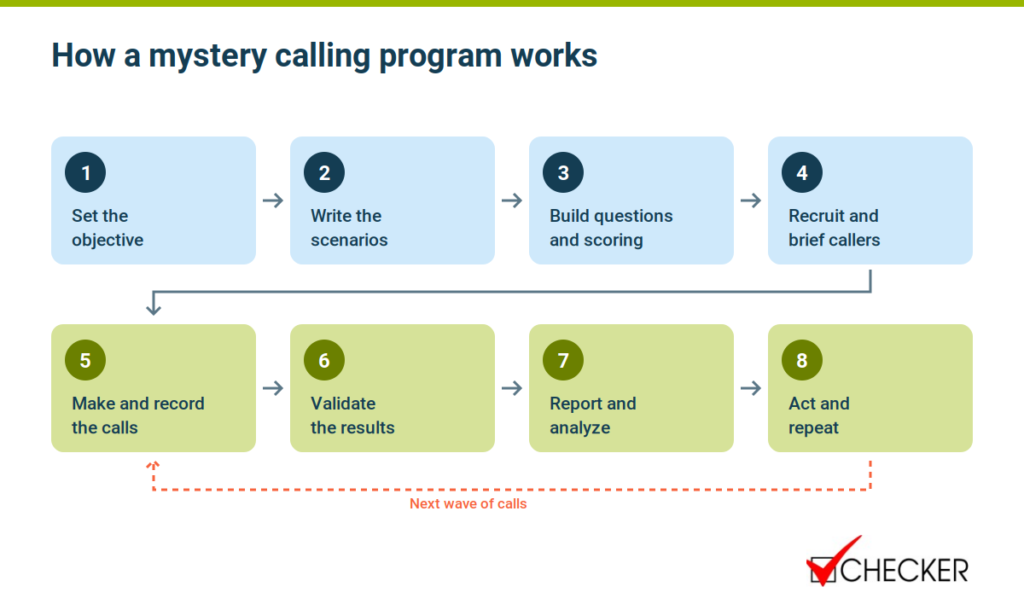
How a mystery calling program works, step by step
1. Set the objective
Start with what you want to learn or improve. Are customers complaining about long waits? Is a new product being explained incorrectly? Are phone enquiries turning into fewer sales than expected? The objective decides which branches, teams or partners to call and what to evaluate.
2. Write the scenarios
Each caller gets a scenario, sometimes called a legend: who they are, why they are calling, what they want to know and how they behave. A caller might be a first-time buyer comparing offers, a customer with a billing complaint, or someone who wants to cancel. Scenarios should be realistic, varied, and based on the real reasons customers call. Add an emotional context, such as a frustrated or hesitant caller, when you want to test how staff cope under pressure.
3. Build the questionnaire and scoring
Turn each objective into specific questions the caller can answer objectively, such as “Did the employee state their name?” rather than “Was the employee friendly?” Weight the questions so the most important behaviors carry the most points.
4. Recruit and brief the callers
Use callers who match the profile of your real customers and can stay in character. Brief them on the scenario, the questionnaire and what counts as a pass or fail, ideally with example recordings.
5. Make the calls and record the evidence
Spread calls across days and times, including busy periods, so results reflect normal service. Where the law allows, record calls: a recording is the strongest evidence, and lets reviewers check scores and use real examples in training.
6. Validate the results
Check each completed questionnaire against the recording and the scenario before it reaches the client. Look for missing answers, scores that contradict comments, and calls that do not match the brief.
7. Report and analyze
Compare results by location, team, time of day and question. Look for patterns rather than individual failures: if every branch fails on the same product question, the problem is training or information, not people.
8. Act and repeat
Use the findings for coaching, training and process changes, then run the next wave of calls to confirm the improvement. Mystery calling works best as a continuous program, not a one-off check.
Sample scenarios and scorecard
Example scenarios
| Scenario | What it tests |
|---|---|
| New customer comparing two products before buying | Needs discovery, product knowledge, sales skills |
| Existing customer who wants to cancel their contract | Retention skills, empathy, policy accuracy |
| Customer with a billing error who is clearly frustrated | Complaint handling, calm communication, resolution |
| Caller asking about a promotion advertised this week | Knowledge of current offers, consistency with marketing |
| Caller who needs a different department | Transfer quality, hold etiquette |
| Caller booking an appointment or test drive | Lead handling, capturing contact details, confirmation |
Example scorecard
| Section | Example questions | Weight |
|---|---|---|
| Accessibility | Answered within 3 rings or 30 seconds? Total hold time under 1 minute? | 15% |
| Greeting | Company name and employee name given? | 10% |
| Needs discovery | At least two questions asked about the caller’s situation? | 15% |
| Knowledge and accuracy | Information correct and complete? Current offer mentioned? | 25% |
| Resolution and next steps | Issue resolved or clear next step agreed? | 15% |
| Communication | Polite, clear, no jargon, no interruptions? | 10% |
| Closing | Summary given, further help offered, contact details captured? | 10% |
Adjust the thresholds and weights to your own service standards. A retention-focused program, for example, would give much more weight to the cancellation handling questions.
A worked example: one scenario from brief to score
To show how the pieces fit together, here is a complete scenario for a fictional mobile operator.
The caller brief (legend)
You are Anna, 34, a customer for three years on a mid-range mobile plan. You have seen a cheaper offer from a competitor and are calling to ask how to cancel. You are polite but firm, and slightly annoyed that your bill went up last month. If the employee presents a better offer, ask about the contract length before deciding. Do not accept an offer during the call; say you will think about it.
What the caller listens for
- How long it takes to reach a person, including the IVR menu
- Whether the employee asks why Anna wants to leave
- Whether they acknowledge the price increase rather than ignoring it
- Whether a retention offer is made, and whether it matches Anna’s reason for leaving
- Whether the contract terms of the offer are explained accurately
- Whether, if Anna still wants to leave, the cancellation process and notice period are explained correctly
- How the call is closed
A sample result
| Section | Observation | Score |
|---|---|---|
| Accessibility | 2 min 40 s in IVR and queue, above the 1 minute target | 0 / 15 |
| Greeting | Company and first name given, friendly tone | 10 / 10 |
| Needs discovery | Asked why Anna wanted to leave, but did not ask about her usage | 8 / 15 |
| Knowledge and accuracy | Offer explained correctly; notice period stated as 14 days instead of 30 | 15 / 25 |
| Resolution and next steps | Offer sent by email as promised | 15 / 15 |
| Communication | Acknowledged the price increase and apologized | 10 / 10 |
| Closing | No summary of the offer conditions | 5 / 10 |
| Total | 63 / 100 |
One call already points to two concrete actions: a staffing or IVR issue behind the long wait, and a knowledge gap on notice periods that may cause complaints later. Across hundreds of calls, patterns like these show exactly where to invest in training and process.
Example: testing phone service in peak season
Peak periods such as Black Friday, the holiday season or January returns are when phone service is under the most pressure, and when a poor call loses the most business. Here is how a retailer or service brand might use mystery calling around a peak.
Baseline wave, four to six weeks before. Callers use the most common peak-season scenarios, such as delivery dates, promotion conditions and returns policy, to measure waiting times and accuracy under normal conditions. Weak answers feed straight into staff briefings before the rush.
Peak wave, during the busiest days. The same scenarios are repeated at the busiest times of day. Comparing the two waves shows how much waiting time, accuracy and courtesy slip under pressure, and which teams hold up best.
Follow-up wave, after the peak. Returns and complaint scenarios test how well the business handles the aftermath, which shapes whether customers come back next year.
Mystery calling metrics to track
| Metric | What it tells you |
|---|---|
| Average speed of answer | How long customers wait before reaching a person |
| Total hold time | Time spent on hold or in transfers during the call |
| Abandonment risk | Share of calls where the wait exceeded your threshold |
| Information accuracy rate | Share of answers that were correct and complete |
| First-call resolution | Share of calls where the issue was resolved without a callback |
| Lead capture rate | Share of sales calls where contact details or an appointment were secured |
| Section and overall scores | Performance by stage of the call and in total |
| Score trend by wave | Whether coaching and training are improving results |
Reading these metrics by location, team and time of day is usually more useful than the overall average, because it shows exactly where to act.
Turning mystery calling results into better service
The value of mystery calling comes from what happens after the report. These practices make the difference between a program that measures and one that improves.
Share results quickly. Feedback given within days of a call is remembered and acted on. Feedback given a month later is not.
Separate system problems from people problems. If most employees give the same wrong answer, the cause is usually missing information, an outdated script or unclear policy. Fix the system first, then coach individuals.
Use recordings in coaching. Let employees hear their own call alongside an example of an excellent one. Hearing the difference is far more persuasive than reading a score.
Recognize good performance. Share high scores and great calls with the whole team. Programs that only highlight failures create anxiety and resistance.
Set targets per section, not just overall. “Raise accuracy on contract terms from 70% to 90%” gives a team something concrete to work on; “raise the score” does not.
Re-test the same scenarios. Repeating a scenario in the next wave shows whether the training actually worked.
Link scores to business results. Comparing mystery calling scores with conversion rates, retention or complaint volumes builds the business case for continued investment in service.
How technology and AI are changing mystery calling
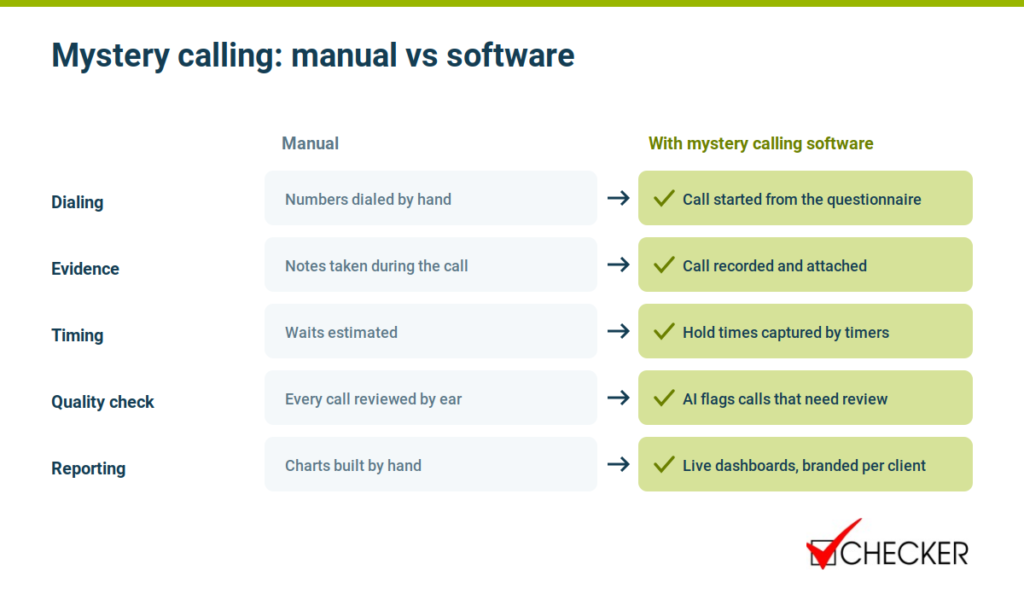
Run manually, mystery calling is slow: callers dial numbers by hand, take notes during the call, type them into a spreadsheet afterwards, and analysts build reports by copying data into charts. Every manual step adds delay and room for error. Purpose-built software removes most of them.
Integrated dialing and recording. Callers start the call from the questionnaire, and the call is recorded and attached to the report automatically.
Smart questionnaires. Routing logic shows only the questions relevant to the scenario and the way the call went, and timers capture waiting and hold times precisely.
Transcription and AI review. Recordings can be transcribed and checked by AI against the questionnaire, flagging answers that do not match what was said, missing evidence or unusual scores. Reviewers focus on the flagged calls instead of listening to every recording in full.
Live dashboards. Results update as calls are completed, so managers see trends during the wave rather than weeks after it. Each client can get a branded dashboard with interactive reports.
Training material. Recordings of excellent and poor calls are the most persuasive training material a business can have, because staff hear real conversations, not theory.
In-house, agency or software: how to choose
There are three common ways to run mystery calling, and many businesses move between them as their program grows.
| Approach | Best for | Watch out for |
|---|---|---|
| In-house, with your own staff as callers | Small, occasional checks | Callers may be recognized; results can be less objective |
| Specialist agency | Ongoing programs, multiple markets, competitor benchmarking | Choose an agency with trained callers, quality control and clear reporting |
| Your own team using mystery calling software | Brands and CX teams that want full control | Requires time to recruit and manage callers |
Questions to ask an agency
- How are callers recruited, trained and matched to scenarios?
- Are calls recorded, and how is recording compliance handled in each country?
- How is each call checked before it reaches the report?
- How quickly are results available, and can we see them in a live dashboard?
- Can mystery calling be combined with mystery shopping, online and other channels in one report?
What to look for in mystery calling software
- Questionnaires with routing logic, timers and mandatory evidence
- Call recording linked to each completed report
- Validation tools, including AI-assisted review
- Scheduling and management of callers and call quotas
- Live, branded dashboards and exports for clients
- Support for other channels, so one platform covers calls, visits and surveys
Legal and ethical considerations
Mystery calling is a widely accepted research practice, but it involves recording and evaluating real employees, so it needs to be set up carefully.
- Call recording rules differ by country. Some jurisdictions allow recording when one party consents; others require everyone on the call to be informed. Check local law, and the client’s own policies, before recording.
- Data protection applies. Recordings and evaluations contain personal data about employees. Under rules such as the GDPR, you need a lawful basis, clear retention periods and secure storage.
- Tell employees the program exists. Staff should know mystery calling is part of quality monitoring, even if they never know which calls are evaluations. This is both good practice and, in many countries, an expectation of labor law or works councils.
- Use results for improvement, not punishment. Programs that coach rather than penalize get better results and better cooperation.
- Respect industry codes. Members of associations such as the MSPA follow ethical standards for mystery shopping, including how evaluations are used.
This section is general information, not legal advice; check the rules that apply in each market you call into.
Common mystery calling mistakes
- Unrealistic scenarios. If the scenario sounds staged, employees spot it and behave differently. Base scenarios on real customer calls.
- Too few calls. One call per location is a snapshot, not a measurement. Plan enough calls to see patterns.
- Calling only at quiet times. Service at 10 am on a Tuesday says little about Saturday afternoon.
- Subjective questions. “Was the employee professional?” means different things to different callers. Ask about specific behaviors.
- No recordings or validation. Without evidence, results are easy to dispute and hard to trust.
- Reports nobody acts on. Agree in advance who receives the results and what happens next.
Frequently asked questions
What is the difference between mystery calling and mystery shopping?
Mystery shopping evaluates the in-person experience in a store, branch or restaurant. Mystery calling evaluates the phone experience. Both use trained evaluators posing as customers, and many programs combine them to compare service across channels.
Is mystery calling legal?
Yes, mystery calling is legal in most countries and widely used. Call recording and the handling of employee data are regulated, however, so check local recording laws and data protection rules before you start.
How many mystery calls do I need?
It depends on your goal and the number of locations or agents. To compare branches, aim for several calls per branch per wave so a single bad call does not distort the result. For an overall picture of a contact center, a larger sample spread across days and times is more reliable.
How often should mystery calling be done?
Most programs run monthly or quarterly waves. Run additional waves around product launches, policy changes and peak seasons.
Can mystery calling be used to evaluate competitors?
Yes. Competitor mystery calling is a common way to benchmark waiting times, product knowledge and sales approach against the market.
Can AI evaluate mystery calls?
AI can transcribe recordings, check them against the questionnaire and flag inconsistencies, which speeds up quality review significantly. Human callers are still needed to make realistic calls and judge nuances of tone and empathy.
How much does mystery calling cost?
Cost depends mainly on the number of calls, the length and complexity of the scenarios, the languages and countries involved, whether calls are recorded and transcribed, and the level of reporting required. Short, simple calls in one language cost much less per call than long scenarios in several markets. Ask providers for a price per completed call so quotes are comparable.
How long does a mystery call take?
Most mystery calls last between 3 and 15 minutes, plus a few minutes to complete the questionnaire. Complex scenarios, such as financial product enquiries, can take longer.
Can employees tell it is a mystery call?
With realistic scenarios and well-trained callers, rarely. The risk rises when scenarios are unusual, when the same scenario is repeated too often, or when callers use the same phone numbers repeatedly.
Can mystery calling be done in several languages and countries?
Yes. International programs use native-speaking callers in each market, with scenarios adapted to local products and customs, and results combined in one report for comparison.
What happens to the call recordings?
Recordings are typically attached to the report as evidence, used for quality review and training, and deleted after an agreed retention period in line with data protection rules.
Conclusion
Mystery calling shows what really happens when customers pick up the phone. With realistic scenarios, objective questions, recorded evidence and fast reporting, it turns thousands of invisible conversations into clear priorities for training and improvement.
Make mystery calling easier with Checker. Checker is a multichannel platform for mystery shopping, CX and VoC research, used by agencies and brands to run mystery calling alongside in-person visits and online surveys, from questionnaire design to AI-assisted review and branded client dashboards. Request a demo