



Mystery shopping is a research method where a trained person (mystery shopper) visits, calls, or browses a business while posing as an ordinary customer, then scores the experience against a set list of criteria. The business gets an objective, repeatable measurement of what actually happens at the front line, rather than what the operations manual says should happen.
It’s also called secret shopping, and the person doing it is a mystery shopper, secret shopper, or mystery customer. Same thing, different label depending on the market you’re in.
Quick note: if you landed here looking for mystery shopper jobs, this article is written for the businesses and agencies that run these programs, not for shoppers looking for jobs.
Why “mystery” matters
The anonymity is the whole point. Staff who know they’re being evaluated behave differently, so any measurement taken during an announced audit tells you what your team can do on a good day. Mystery shopping tells you what your customers get on a normal one.
That’s also the line between mystery shopping and a customer survey. A survey asks people who chose to answer how they felt. Mystery shopping sends a specific person to a specific location at a specific time, with a specific checklist, so the results are comparable across every branch and every month.
| Mystery shopping | Customer surveys / reviews | |
| Who reports | A briefed evaluator you control | Whoever decides to respond |
| What you get | Objective, scored observations | Perceptions and emotions |
| Comparability | High — same checklist everywhere | Low — free-form, self-selected |
| Best for | Auditing process, compliance, standards | Measuring satisfaction and loyalty |
Most serious programs run both. Mystery shopping tells you what happened; Voice-of-Customer research tells you how people felt about it. Together they explain each other.
How mystery shopping works, step by step
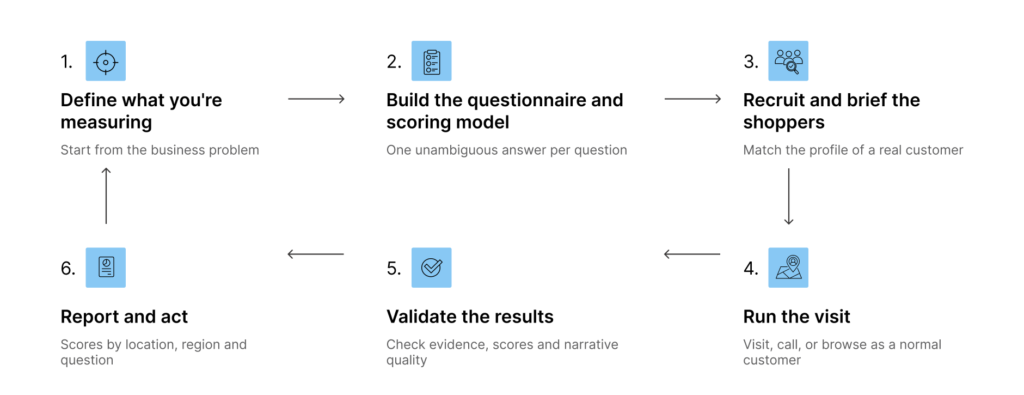
A mystery shopping program is a research project, not a spot check. Six stages, roughly:
1. Define what you’re measuring
Pick the behaviours that matter commercially. “Was the store clean” is easy to measure and rarely changes revenue. “Did the advisor ask about the customer’s budget before recommending a product” changes revenue. Start from the business problem, then work back to observable behaviours.
2. Build the questionnaire and the scoring model
Every question needs one unambiguous answer. Vague questions produce vague data. This stage also decides weighting: if regulatory compliance matters more than upselling, the scoring has to reflect that, or your average score will hide the thing you care most about. Questionnaire and scoring setup is also the most important step in the project management workflow.
3. Recruit and brief the shoppers
Shoppers need to match the profile of a real customer for that location. A luxury-watch retailer needs a shopper who looks like a plausible buyer. A student-account audit at a bank needs a student. The brief tells them the scenario, the timing, what to request, what evidence to capture, and what to avoid so they don’t blow their cover.
4. Run the visit
The shopper visits, calls, emails, or completes a purchase online, behaving like a normal customer throughout. They don’t intervene, hint, or help. Then they complete the evaluation form, ideally within a couple of hours while the detail is fresh, and attach evidence: receipts, photos, timestamps, call recordings where the law allows.
5. Validate the results
This is the stage most people underestimate. Reports get checked for internal contradictions, missing evidence, comments that don’t support the score given, and narrative quality. Weak validation is how a program loses credibility with the operations team it’s meant to serve, and once they stop trusting the data, they stop acting on it.
6. Report and act
Validated results roll up into reports: scores per location, per region, per question, tracked over time. The useful output isn’t the score. It’s the answer to “which three things should this branch fix this month,” delivered while it’s still current.
Then it repeats. A single wave of mystery shopping is a snapshot. Value comes from running it on a cycle, so you can see whether last quarter’s coaching actually changed behaviour.
What mystery shopping actually measures?
Depends on the question you’re asking, but programs generally cover:
- Service behaviours: greeting, needs discovery, product knowledge, closing, follow-up
- Compliance: mandatory disclosures, age verification, documented procedures, script adherence
- Process and speed: wait times, queue handling, resolution times, call transfers
- Standards: cleanliness, stock availability, pricing accuracy, merchandising, signage
- Sales execution: was the offer presented, was the cross-sell attempted, was the correct product recommended
- Digital experience: checkout friction, response times to web enquiries, chat and email quality
- Competitors: the same checklist applied to rivals, which is the only way to know whether an 82% score is good or mediocre for your category
Real examples of mystery shopping across industries
A restaurant group measuring service consistency
Shoppers dine at 40 locations each quarter, timing how long until they’re greeted, whether specials were mentioned, whether the server checked back after the food arrived, and whether the bill was accurate. The group finds that two regions are 20 points behind on the check-back question and retrains those managers specifically, rather than rolling out a generic service program everywhere.
A bank checking regulatory compliance
Shoppers pose as customers asking about a loan or investment product. The evaluation captures whether the advisor ran the suitability questions, disclosed the fees, explained the risks, and offered the required documentation. Here the score isn’t a nice-to-have. It’s evidence that branches are following the process the regulator expects, gathered before an auditor finds the gap.
A retailer auditing staff behaviour
An electronics chain wants to know if staff are actually asking what the customer intends to use the product for, because analysis shows those conversations correlate with higher-value baskets and fewer returns. Mystery shopping measures how often that question gets asked, by store and by shift.
A hotel chain testing the whole journey
One assignment covers the booking call, the email confirmation, check-in, the room, breakfast, a maintenance request, and check-out. Long evaluations like these produce a lot of detail, which is exactly why hospitality programs live or die on data collection that doesn’t fail halfway through.
A telecom auditing its call centre
Shoppers call with a defined problem: a billing dispute, a cancellation request, a technical fault. The evaluation scores hold time, whether the agent identified the issue correctly, whether they attempted retention, and tone throughout.
An insurer checking its digital funnel
Shoppers request a quote through the website and score what happens next: how long the callback took, whether the agent knew the enquiry existed, whether the quote matched what the site displayed. Digital mystery shopping catches the gaps between channels that no single-channel metric ever shows.
Why businesses invest in mystery shopping?
During over 20 years of providing services for our clients, we have figured out these three reasons, in order of how often they come up as the reasons businesses invest in mystery shopping:
1. You can’t manage what you can’t see
A multi-site brand has no other reliable way than mystery shopping to know whether the standards defined at head office are complied and implemented correctly at all branches.
2. Compliance risk is expensive
In regulated sectors, mystery shopping is the cheapest possible way to find a process failure. It’s cheaper than a regulator finding it, and cheaper than a lawsuit.
3. Coaching needs specifics
Simply say “Improving customer service” in the coaching section doesn’t change staff behaviour as you expect. With mystery shopping, you can be more specific with data collected. For example, “Your team asks the qualifying question 34% of the time and the top-performing region is at 78%. You should take this as a benchmark, and we need to see improvement in the next month”.
For market research agencies, there’s the fourth reason. Mystery shopping is a recurring revenue line. Satisfaction studies are project work. Mystery shopping programs run monthly or quarterly, on contract, for years.
Mystery shopping in 2026 and beyond
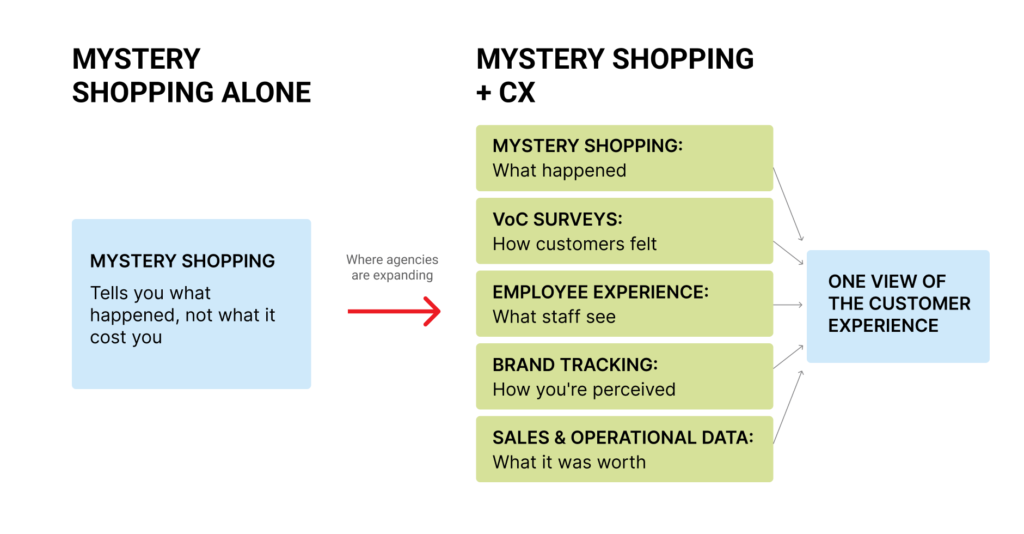
From standalone audits to full CX programs
Mystery shopping as a standalone service is not going away. It answers a question nothing else answers: what actually happened at the counter, on the call, in the checkout flow. No survey, review score or operational dashboard replaces that.
What has changed is how rarely it gets bought on its own. Mystery shopping tells you what happened, but not what it cost you. A branch can score 91% and still lose customers, because the checklist covered the process and missed the reason people left. That gap is why clients increasingly ask for mystery shopping alongside the rest o
f their customer experience measurement: post-visit satisfaction surveys, NPS and CSAT tracking, employee experience and brand tracking.
Run together, those methods explain each other. Mystery shopping finds that the qualifying question gets asked 34% of the time. Voice-of-Customer data shows
the customers who were never asked report lower confidence in what they were sold. Sales data shows those baskets are smaller. At that point you are not handing the client a score, you are handing them a business case, and that is the difference between a report that gets read and a report that gets acted on.
What this means for agencies?
The commercial pull runs the same way. Agencies that started out selling mystery shopping only are broadening into CX, adding VoC surveys, employee feedback and brand tracking to the programs they already run. Two reasons it works. First, contract value per client goes up without a new sales cycle, because you are selling more to a client who already trusts your data. Second, defensibility: a mystery-shopping-only contract is easy for a procurement team to re-tender on price, while a program that measures the client’s whole customer experience is not.
The market trend
Widening the offer only pays if the data lands in one place. Bolting a separate survey tool onto a separate mystery shopping tool gives your team two logins, two exports and a manual merge every reporting cycle. That is where most expansions stall, not at the selling stage. Before you add a service line, check that your platform can run it on the same panel, the same scoring logic and the same dashboard your client already looks at.
Who runs mystery shopping programs
There are two models a business tends to use to run a mystery shopping program, which are partnering to the agencies or building up an internal team.
Specialist agencies: Mystery shopping companies and market research agencies design the study, manage a shopper panel, validate the reports, and deliver insight to the client. Most large programs run this way, because recruiting and quality-controlling a shopper network is a real operational capability that brands rarely want to build in-house.
In-house teams. Larger brands sometimes run their own programs, usually on top of a platform, with a recruiting partner filling the shopper gap.
Either way the bottleneck is the same, and it isn’t finding shoppers. It’s everything after the visit, including getting completed evaluations in without data loss, validating them at speed, and getting reports to the people who can act while the findings still matter. That’s the work that eats an agency’s margin, and it’s what mystery shopping software exists to remove.
What the manual work costs in mystery shopping
At Checker, we work with both brands and agencies. When discussing where they usually waste time the most, we heard nearly the same four answers.
1. Programming questionnaires by hand
Complex evaluations with conditional logic and weighted scoring take days to build and rebuild every time a client changes the brief.
2. Losing data in the field
A shopper completes a 100-question hotel evaluation, the hotel Wi-Fi drops, and the whole thing is gone. They re-enter it from memory, or they quit the panel. Checker’s iOS and Android app stores every response locally in full offline mode, so nothing depends on connectivity at the moment of capture.
3. Validating reports manually
Reading every submitted evaluation for coherence and grammar doesn’t scale past a certain volume. AI-assisted grammar and coherence checks, plus automated penalty and bonus scoring, take the routine passes off the reviewer’s desk so human attention goes to the reports that actually need judgment.
4. Chasing reports across formats
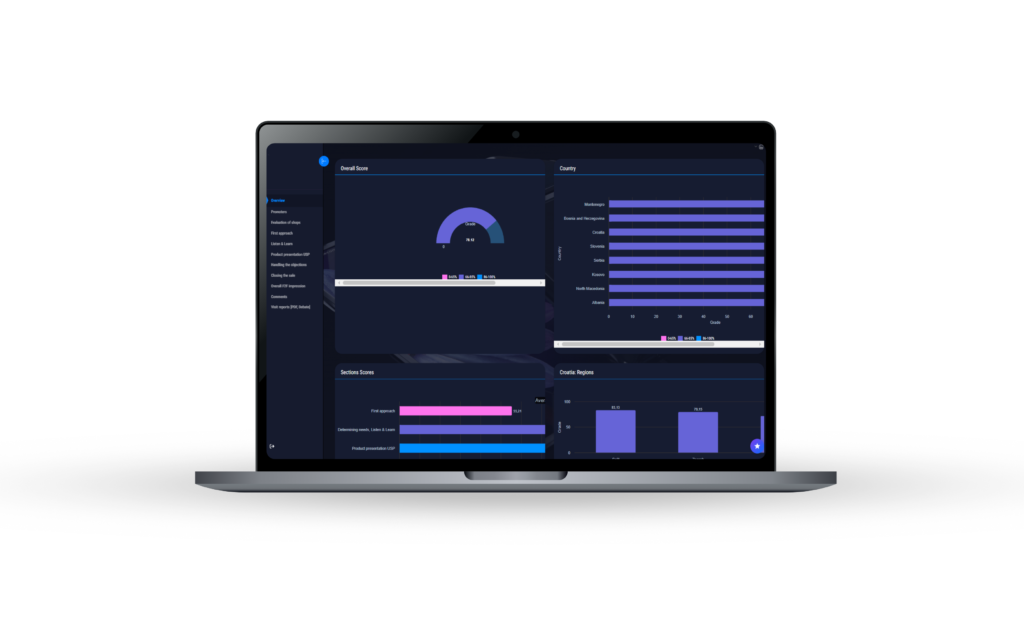
Results arriving as spreadsheets, emails, and exports get consolidated by hand. Importing via CSV, Excel, XML, API feeds and direct connectors into real-time dashboards means clients see scores as data lands, with role-based access so each manager sees only their own locations.
None of that changes what mystery shopping is. It changes how much time your team consumes in a week.
See it on your own program
Checker has spent 20+ years in mystery shopping and CX research and runs programs across 60 countries. If you’re launching a program, or you’re running one on a platform that’s fighting you, struggling with building questionnaires by hand, losing data or chasing report across formats. It’s time to consider a new professional like Checker.
Checke Software Systems was built for both halves of that job. It runs A-to-Z mystery shopping campaigns. From questionnaire design and shopper and field management through offline data collection, validation and reporting, and it carries the CX side on the same platform. Including customer experience and Voice-of-Customer surveys, employee experience and brand tracking, collected over SMS, email, phone, web and field channels. For an agency, that is the practical route from selling mystery shopping to giving clients a full view of their customer experience. Without adding a second system to your stack or a second export to your reporting cycle.
Book a demo for free and we’ll walk through your program setup, not a generic slide deck.
FAQ
A person briefed to visit, call, or contact a business as an ordinary customer and then score the experience against a defined checklist. They’re paid per assignment and are usually part of a panel managed by a mystery shopping agency.
Yes, and it’s a standard research practice in retail, hospitality, banking, automotive, and telecoms. What varies by country is the detail: recording conversations, capturing images, and processing personal data all have local rules. In the EU, programs need to be GDPR-compliant in how shopper and staff data is collected, stored, and shared.
A survey collects opinions from customers who choose to respond. Mystery shopping collects observations from evaluators you brief, at times you choose, against criteria you set. Surveys tell you how people feel; mystery shopping tells you what happened.
Frequency depends on how fast the behaviour you’re measuring drifts. Monthly or quarterly cycles are common for multi-site retail and hospitality; compliance-driven programs in regulated sectors often run more often. What matters more than frequency is consistency: the same questionnaire over time is what turns scores into a trend you can act on.
Yes. Digital mystery shopping covers websites, apps, chat, email response, and phone channels — often as part of a single assignment that follows one customer journey across several channels at once.
You should have an all in one platform to do mystery shopping effective. Unless, the manual work compounds: questionnaire programming, field management, validation, and reporting all scale badly on spreadsheets, and offline data loss becomes a recurring cost. A platform is what makes a program repeatable rather than a project you gotta renew time after time.


