


A study rarely goes wrong at the analysis stage. It goes wrong earlier, in the fieldwork, when the phone team is working out of one system. The online survey lives in another. The in-person interviewers are on a tablet app. And somewhere a stack of paper questionnaires is waiting to be keyed in. Four data collection methods, four tools, and one person whose job that week is stitching the outputs into a single clean dataset before the client deadline.
That reconciliation step is where agency margin quietly disappears. So before choosing a method for a study, it helps to be clear on what each one actually is, what it costs you in cost, speed, reach and data quality, and when running more than one in the same study is the right call rather than a headache. This guide compares the four main fieldwork modes, explains multi-mode collection, and is honest about the operational cost of keeping them in separate systems.
The three main data collection methods
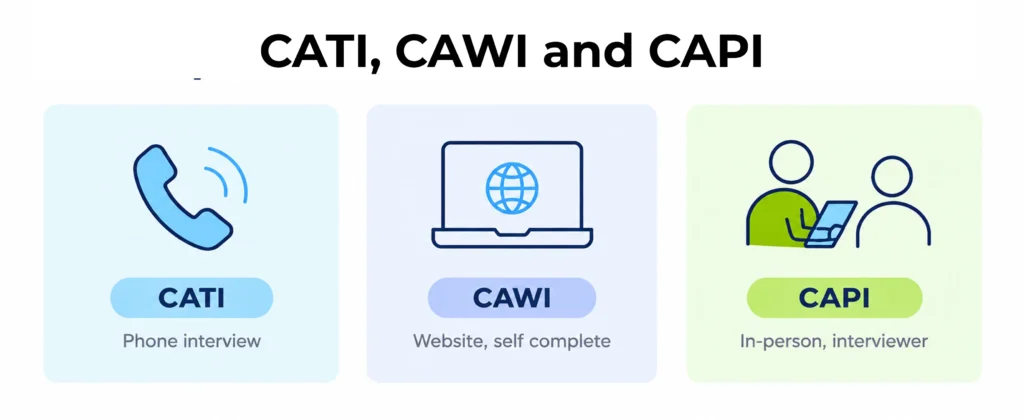
The industry uses three acronyms for how a questionnaire actually reaches a respondent. Each describes the medium and whether an interviewer is involved.
- CATI (Computer-Assisted Telephone Interviewing): an interviewer calls the respondent and reads questions from a screen, entering answers as they go.
- CAWI (Computer-Assisted Web Interviewing): the respondent completes an online survey themselves, with no interviewer present.
- CAPI (Computer-Assisted Personal Interviewing): an interviewer meets the respondent face to face and administers the questionnaire on a laptop, tablet, or phone.
The split that matters most for your budget and your data is interviewer versus self-completion. CATI and CAPI put a trained person between the question and the answer, which improves quality and lets you probe, but costs interviewer time. CAWI removes that person, which makes it cheap and fast but hands control to the respondent.
CATI, CAWI, and CAPI compared
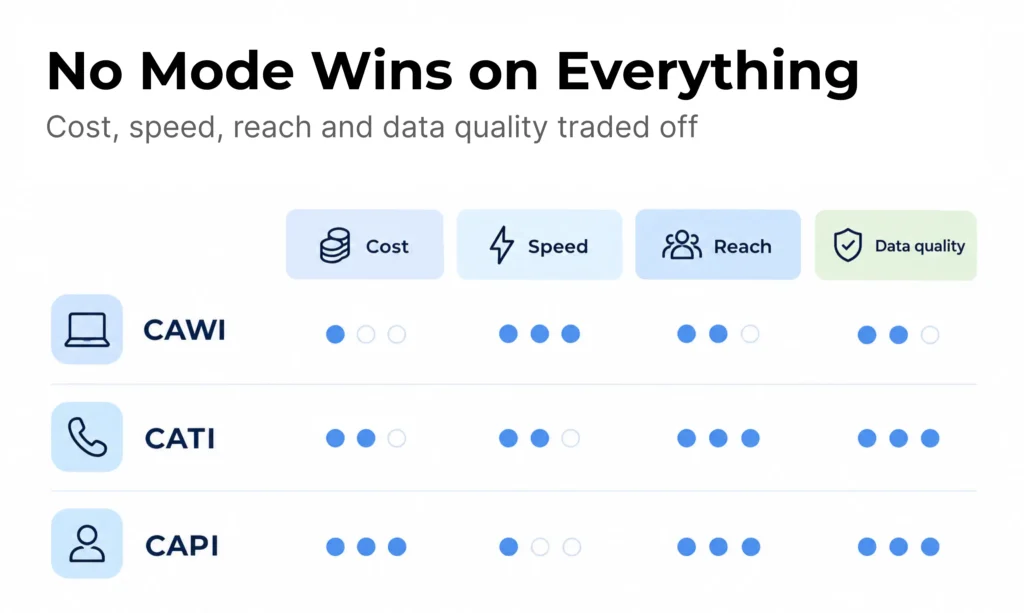
No mode is best in the abstract. Each trades one of cost, speed, reach and data quality against the others. The table below is a practical starting point. And the notes underneath explain why each cell lands where it does.
| Method | Cost | Speed | Reach | Data quality |
| CAWI (web) | Lowest | Fastest | Wide, but only people you can reach and who will self-complete online | Good on structured questions, no interviewer to clarify, so straightlining and drop-off are risks |
| CATI (phone) | Medium to high (interviewer time) | Moderate | Broad, including people who are not online, though answer rates keep falling | High, interviewer can clarify and probe, but phone limits question length and complexity |
| CAPI (in person) | Highest (interviewer plus travel) | Slowest | Strong for hard-to-reach, in-context, and long or complex interviews | Highest, interviewer can show stimuli, observe, and hold attention for long questionnaires |
A few things worth pulling out of the table.
CAWI is cheap and fast for a reason, and the reason is also its weakness. Removing the interviewer removes the biggest cost and the biggest delay. It also removes the person who would have caught a misread question or nudged a bored respondent who is clicking straight down the middle column. For short, well-designed surveys of an online-reachable audience, that trade is usually worth it. For a long or sensitive questionnaire, it starts to hurt.
CATI and CAPI buy you quality with labor. The interviewer is the feature you are paying for. They clarify, probe open answers, and keep a respondent engaged through a 30-minute interview that would have been abandoned online. CAPI adds the ability to show materials and read body language, which is why it survives for in-depth and in-context work despite being the most expensive mode to field.
What multi-mode data collection is, and when to mix modes
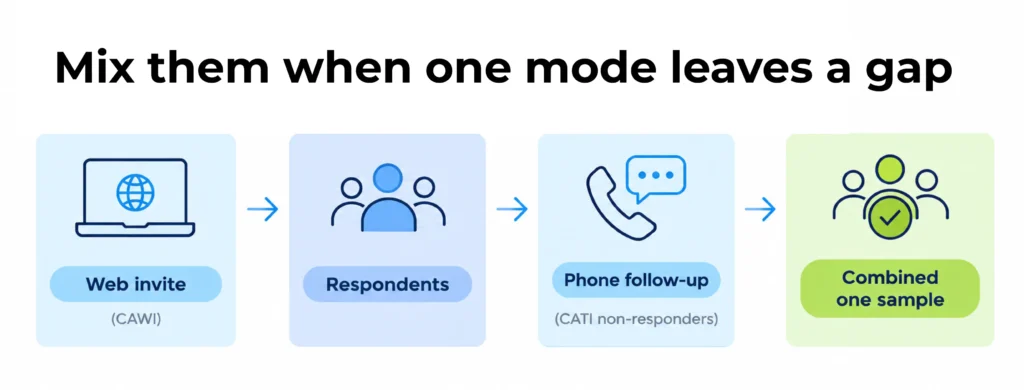
Multi-mode data collection means running more than one of these methods in a single study, either offering respondents a choice of mode or using one mode to reach the people another mode missed. A common pattern is a web-first design (CAWI) with a phone follow-up (CATI) for people who did not respond online, so you lift the response rate and reduce the bias that comes from surveying only the online-and-willing.
Mixing modes is the right call when a single method leaves a hole:
- You need coverage a single mode cannot give. Older or offline populations are hard to reach by CAWI alone; a CATI or CAPI layer fills the gap.
- You are pushing for a higher response rate. Giving people a second way to respond, or chasing non-responders in a different mode, lifts completion.
- You are running across several countries. Infrastructure differs by market. One country is comfortably online, another still needs phone or in-person work. A multi-country study is multi-mode by necessity.
- You are balancing cost against quality. Collect the easy, cheap completes by web, and reserve expensive interviewer time for the segments that genuinely need it.
There is an honest trade-off, and any agency that has run mixed-mode studies knows it. Different modes can produce slightly different answers to the same question, an effect researchers call mode effect. A respondent may report more honestly to a screen than to a live interviewer on a sensitive topic, for example. If you are comparing results across modes, you have to design the instrument to be as consistent as possible across them and be aware of the effect when you interpret the data. Multi-mode is a coverage and response tool, not a free lunch.
The real agency problem in data collection
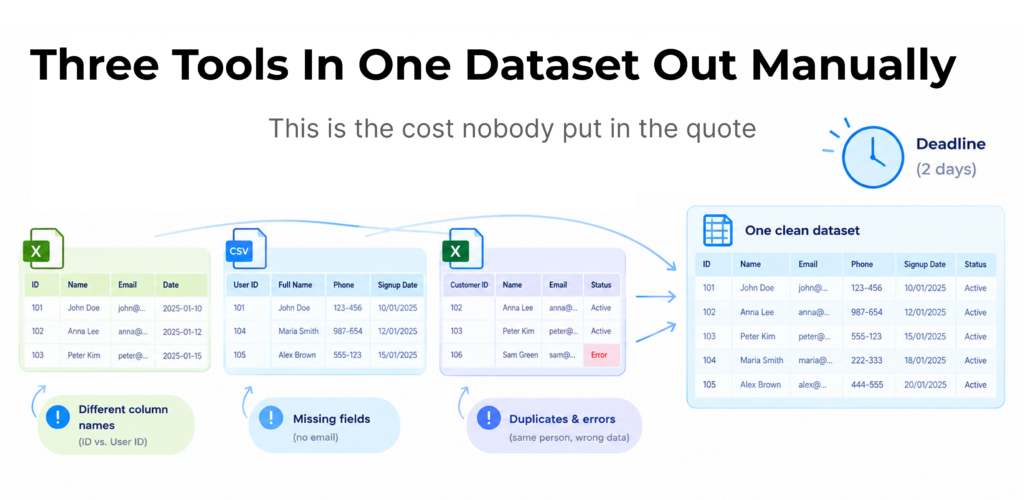
The real agency problem is not the method. It is the tool per method.
Here is the part the textbook comparison leaves out. Choosing the right mode is the easy decision. Living with it operationally is where the cost lands. Because in most agencies each mode sits in a different piece of software.
The phone team runs a CATI system. The online survey is built in a separate web survey tool. The field interviewers use a CAPI app, often a third product. Every one of those systems exports data in its own format, with its own field names, its own coding, its own quirks. Then a study runs across two or three of them at once, and someone has to pull it all together.
That someone spends the back half of the project reconciling it all afterwards by hand. Such as matching fields, recoding values, resolving duplicates, chasing down the mismatches between systems, and rebuilding one dataset the analysts can actually use. It is slow, error-prone, and it scales badly. Take on more projects and you do not just add fieldwork. You add reconciliation, and reconciliation is the task that quietly caps how many studies a small team can run. And even worse, it happens at the end, under deadline, which is exactly when mistakes are most expensive and hardest to catch.
This is where the fragmentation stops being an annoyance and starts eating margin. Most agency studies are priced as a fixed fee. So every hour spent merging exports, recoding values is time you already sold, now being paid for twice. A redone CAPI interview or a transcription error caught late is not a productivity footnote. It is cost coming straight off the project’s profit. The mode you chose was the right one. The two or three disconnected tools you ran it through are the line item nobody put in the quote.
The tool sprawl also creates smaller daily frictions. Field data collected on a weak connection can be lost if the app is not built for full offline capture, so a long CAPI interview has to be redone. Client access is awkward when the live data lives in a tool the client cannot see. And QA has to be repeated separately in each system, because none of them shares a quality check.
What one platform across every mode actually changes
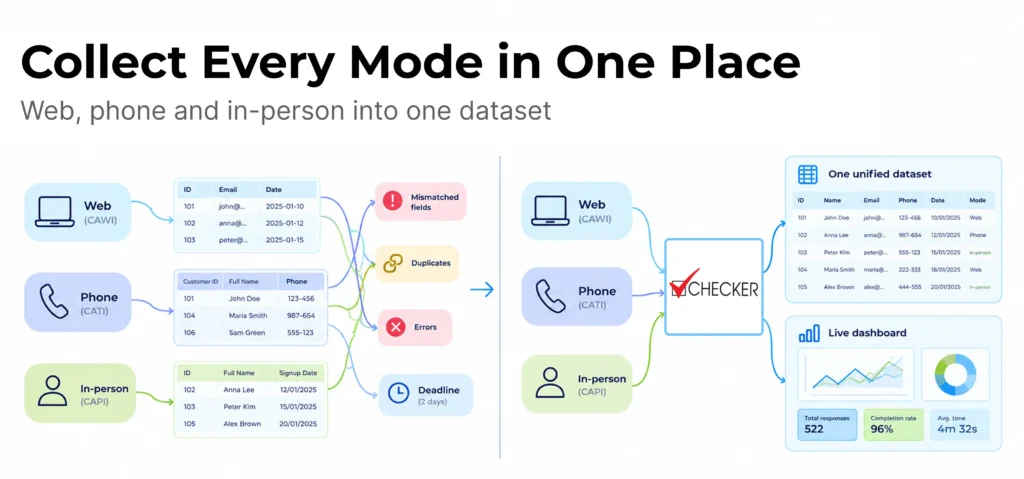
The fix is not a better spreadsheet for reconciliation. It is not needing the reconciliation step at all. Because web, phone, in-person and field collection run on the same engine and land in the same dataset from the start.
When one platform that collects across every mode handles CATI, CAWI, and CAPI together, a few things change in practice:
- No re-keying and no reconciling. Every mode writes to one structure, so there is no matching fields across exports, no recoding, no merge step at the end. The dataset is assembled as the data arrives.
- A genuinely offline mobile app for the field. CAPI and field interviews save on the device and sync when a connection returns, so a long interview on weak Wi-Fi is never lost and never re-entered. People used to fall back to paper for the offline reliability of paper without the manual data entry that follows it.
- Automated ingestion for anything that does start outside the platform. Import via CSV, Excel, XML, and API, so even legacy inputs flow in without someone typing them.
- One real-time view for you and the client. Results are visible the moment data lands, with role-based access so each client sees only their own study. No exporting a static file to show progress.
- One QA pass, not one per tool. Automated grammar and coherence checks and consistent scoring run across all modes in the same place, instead of being repeated system by system.
For an agency, the outcome is margin and capacity at once. The reconciliation hours you were paying for twice come back. And the same team runs more studies because the fieldwork ends when the fieldwork ends, not when the reconciliation finally does. You are no longer absorbing the cost of the tool sprawl on every fixed-fee project. For EU work specifically, keeping all modes on one platform also makes GDPR-grade data handling a single, defensible setup rather than a compliance question you have to answer separately for four different tools.
This is the logic behind where data collection sits inside a wider market research software decision. And it is the specific problem Checker was built to remove.
How to choose, in one paragraph
Match the mode to the study, not to habit.
- Short survey, online-reachable audience, tight budget: lead with CAWI.
- Need to reach people who are not online, or a questionnaire too involved for self-completion: add or use CATI.
- In-depth, in-context, or stimulus-based work: CAPI earns its cost.
Then, before you commit, ask the operational question that the acronyms hide. How many separate tools will this study touch, and who is reconciling the output? If the answer is more than one tool and a person’s week, that is the margin to design out.
Run every data collection mode in one place
The method comparison is the part everyone knows. The part that decides whether a study is profitable is operational. How many tools the fieldwork touches, and how much of your team’s week goes into merging their outputs by hand. Pick the mode that fits the study, then remove the tax that comes from collecting each mode somewhere different.
That is what Checker does. Web, phone, in-person and field collection on one platform, with a fully offline mobile app for fieldwork, automated ingestion for anything else, one QA pass across every mode, and real-time role-based dashboards you and your clients can watch live. Twenty years of running fieldwork across 60 countries went into making the modes work together instead of against each other.
Book a demo and bring a real mixed-mode study. We will show you how it runs end to end in one place, with no separate tools to reconcile afterwards.
Frequently asked questions
CATI is Computer-Assisted Telephone Interviewing, where an interviewer calls and records answers on screen. CAWI is Computer-Assisted Web Interviewing, an online survey the respondent completes themselves. CAPI is Computer-Assisted Personal Interviewing, a face-to-face interview run on a device. You may also see the older PAPI, paper-and-pencil interviewing, but paper has largely been replaced by these device-based modes.
CAWI (web) is normally the cheapest and fastest, because there is no interviewer cost and responses arrive instantly. The trade-off is that it only reaches people you can contact online and who will self-complete, and there is no interviewer to clarify a question or keep a respondent engaged, so long or complex surveys suffer.
It is running more than one method in the same study, either letting respondents choose a mode or using one mode to reach people another mode missed, such as a web survey with a phone follow-up for non-responders. It improves coverage and response rates but requires a consistent questionnaire across modes, because different modes can produce slightly different answers to the same question.
Mix modes when one method leaves a coverage gap (offline or hard-to-reach populations), when you are pushing for a higher response rate, when a study spans countries with different infrastructure, or when you want to collect cheap completes by web and reserve interviewer time for the segments that need it.
Yes. A multi-mode platform collects web, phone, in-person and field responses on one engine so they land in a single dataset with no re-keying or reconciliation. A full offline mobile app covers fieldwork by storing responses on the device and syncing later, giving CAPI the reliability teams once used paper for, without the manual data entry that followed it.


