


A mystery shopper’s job is to experience a business exactly as a real customer would, then describe that experience so clearly and objectively that the business can act on it. Done well, a single visit can change how a store trains its staff, how a restaurant runs its busiest shift, or how a bank explains its products. The mystery shopping tips below cover every stage, from reading the brief to filing a report your client can trust.
The difference between an average shopper and an excellent one is rarely about luck. It comes from preparation, observation, discretion and, above all, the quality of the report. In this guide, we share ten practical secrets from experienced mystery shoppers and the agencies that work with them, followed by a visit checklist, examples of weak and strong report comments, tips for different channels, and how to avoid the most common mistakes.
What is mystery shopping, and how does it work?
Mystery shopping is a research method in which a trained evaluator poses as an ordinary customer, follows a defined scenario and reports on the experience against the business’s standards. Because staff do not know they are being evaluated, it shows the service real customers receive.
A typical program works like this: a business or its mystery shopping agency defines the objectives and the questionnaire, the agency assigns visits to shoppers who match the customer profile, shoppers carry out the visit and submit a report, the agency checks each report, and the client receives the results to act on.
The main types are:
- In-person visits to stores, restaurants, hotels, branches, showrooms and other locations.
- Phone mystery shopping (mystery calling) to test contact centers, bookings and sales lines.
- Online mystery shopping of websites, live chat, email, social media and online ordering.
- Full-journey or hybrid shops that follow a customer across several channels, for example an online enquiry, a phone call and a store visit, to test how well the channels work together.
Everyday shoppers and expert shoppers
Most assignments are designed for everyday shoppers: people who match the business’s typical customers and need no specialist knowledge. Some assignments call for expert shoppers with professional knowledge, such as a mechanic evaluating whether a car repair diagnosis was correct, a pharmacist assessing advice in a pharmacy, or a financial professional judging whether a bank adviser met regulatory requirements. Expert shops answer questions an everyday customer could not judge reliably, and are usually paid more.
10 mystery shopping tips for effective visits
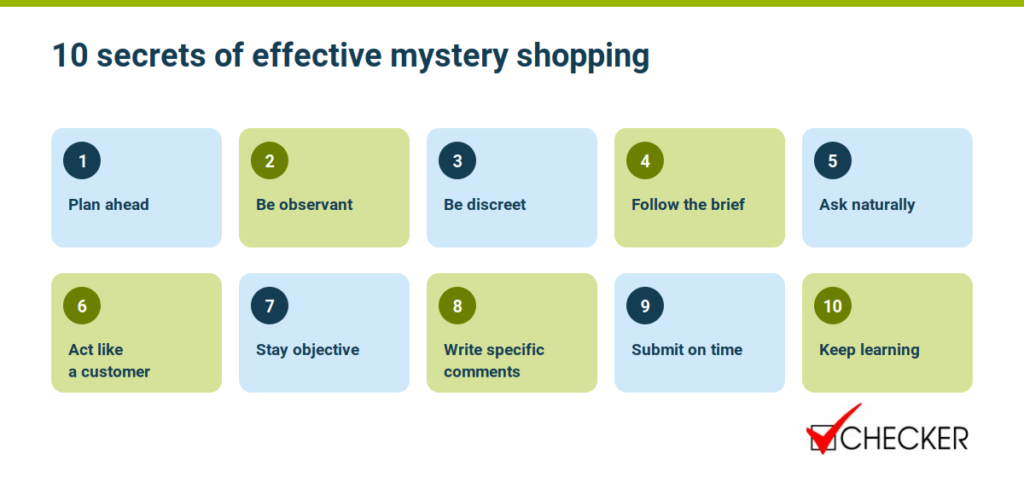
1. Plan ahead
Read the guidelines and the full questionnaire before the visit, not in the car park. Know exactly what you must observe, what you must buy or ask, what evidence is required (receipts, photos, business cards, names) and the time window for the visit. Check the location’s opening hours and how busy it is likely to be.
In practice: Write a short personal checklist of the five or six things you are most likely to forget, such as the employee’s name, the time you were greeted or the exact wording of the closing. Use the agency’s mobile app to review the questionnaire offline beforehand, so there are no surprises.
2. Be observant from start to finish
The evaluation starts before you enter and ends after you leave. Notice the exterior, parking and signage; the moment you are first acknowledged; how staff interact with you and with other customers; cleanliness, displays and atmosphere; and what happens as you leave.
In practice: Mentally divide the visit into stages (arrival, greeting, needs, offer, closing, departure) and note one or two facts at each stage. Times matter: glance at your watch or phone discreetly as you enter, when you are greeted and when you leave.
3. Be discreet
Your goal is to be indistinguishable from any other customer. Do not take notes openly, read the questionnaire on your phone or take obvious photos. If you need to capture details, do it naturally: checking your phone as any customer would, or noting things down in your car straight after the visit.
In practice: Record only when the assignment explicitly asks for it and the law in that country allows it. Covert recording is illegal in some places and against many agencies’ rules, so never improvise it.
4. Follow the instructions exactly
The client designed the scenario to measure something specific. If the brief says to ask about a particular product, visit on a weekday afternoon or pay by card, do exactly that. A visit that does not follow the brief cannot be compared with other visits and may not be accepted, or paid.
In practice: If something prevents you from following the brief, such as a closed store or a product that no longer exists, contact the agency before improvising, and explain what happened in the report.
5. Ask the right questions, naturally
Questions are how you test knowledge and service. Prepare the questions in the scenario and a few natural follow-ups. Ask them as a real customer would, at a natural pace, and let the employee do the talking.
In practice: Avoid trick questions or interrogating staff. Two or three thoughtful questions reveal far more than ten rapid-fire ones, and do not make you stand out.
6. Act like a real customer
Behave consistently with the profile in your brief: a first-time buyer is a little unsure, a returning customer knows the basics, a busy professional is short on time. Make the purchase or request that a real customer would make, and react naturally to what the employee says.
In practice: Do not try to catch staff out or be deliberately difficult unless the scenario asks you to test complaint handling. The goal is to experience normal service, not to provoke a failure.
Dress the part. Your appearance should match the customer you are playing and the place you are visiting: smart clothes for a luxury boutique or a car showroom, casual clothes for a fast-food restaurant, sportswear for a gym tour. Looking out of place is one of the quickest ways to be noticed, and staff may treat you differently because of it.
7. Stay objective
Report what happened, not how you personally felt about it. Your taste in music, your opinion of the brand or a bad day should not influence the score. Where a question asks for an opinion, explain the facts behind it.
In practice: For every negative score, ask yourself: “Could I describe exactly what I saw or heard that led to this?” If not, reconsider the score.
8. Write specific, actionable comments
The report is the product. Clients read comments to understand what to change, so specific facts are far more valuable than general impressions. Name what happened, when and by whom, and how it compares with the standard.
In practice: See the examples of weak and strong comments below. A strong comment answers who, what, when and how, in neutral language.
9. Submit on time
Complete the report as soon as possible after the visit, ideally within an hour and always within the agency’s deadline. Memory fades quickly, and late reports delay results for the client.
In practice: Block time in your day straight after each visit for the report. Using a mobile app that works offline lets you complete most of it in the car or on public transport.
Stay organized when you take on several assignments. Keep one calendar or tracking sheet with every assignment’s date and time window, location, scenario, required evidence, report deadline and payment status. Plan routes so visits in the same area happen on the same day, but leave enough time between visits to write each report before the next one, so details from different locations never get mixed up. Reliable, organized shoppers are the ones agencies offer the most work.
10. Keep learning
Read feedback from the agency’s editors on every report and apply it to the next one. Learn the standards of the industries you shop most often, and the guidelines of professional bodies such as the MSPA.
In practice: Keep a personal list of editor comments and recurring mistakes. Shoppers who improve their reports quickly tend to be offered more, and better paid, assignments.
Before, during and after the visit: a checklist
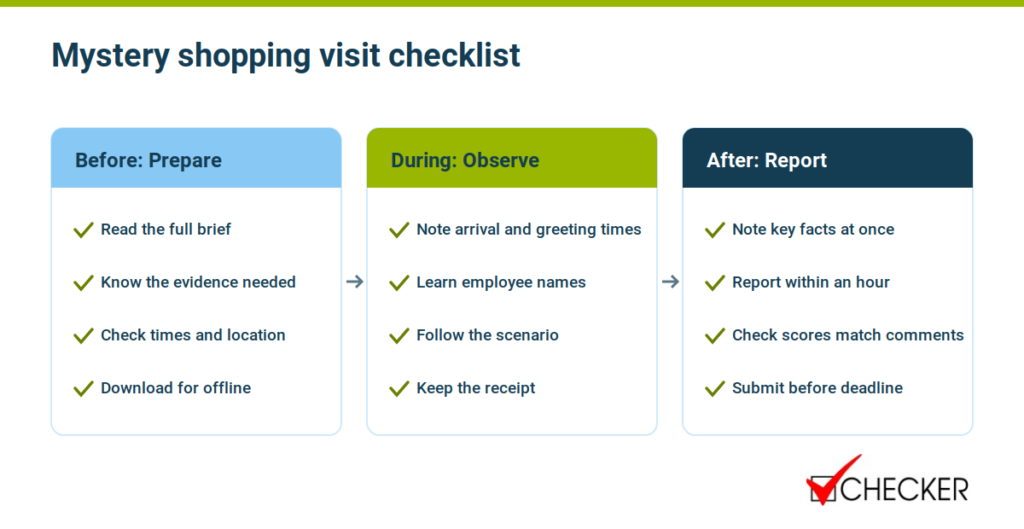
Before the visit
- Read the guidelines and the full questionnaire
- Note the scenario, profile, questions to ask and purchase to make
- Check the visit window, location, opening hours and expected busy times
- Know what evidence is required: receipt, photos, names, business card, times
- Charge your phone and download the questionnaire for offline use
- Dress and behave in line with the customer profile
During the visit
- Note the time you arrive, are greeted and leave
- Learn the names of employees you deal with, or a description if no name badge
- Follow the scenario and ask the planned questions naturally
- Observe cleanliness, displays, signage and atmosphere
- Make the required purchase and keep the receipt
- Capture evidence only as instructed, and discreetly
After the visit
- Write down key facts immediately, before you drive away or walk off
- Complete the report while details are fresh, ideally within an hour
- Check every answer matches your comments, and comments match each other
- Attach receipts and photos, and check they are readable
- Proofread the narrative for clarity, spelling and neutral tone
- Submit before the deadline and respond quickly to any editor questions
How to write a report that gets approved
Agencies review every report before it reaches the client. The reports that pass first time share four qualities: they are factual, specific, consistent and neutral.
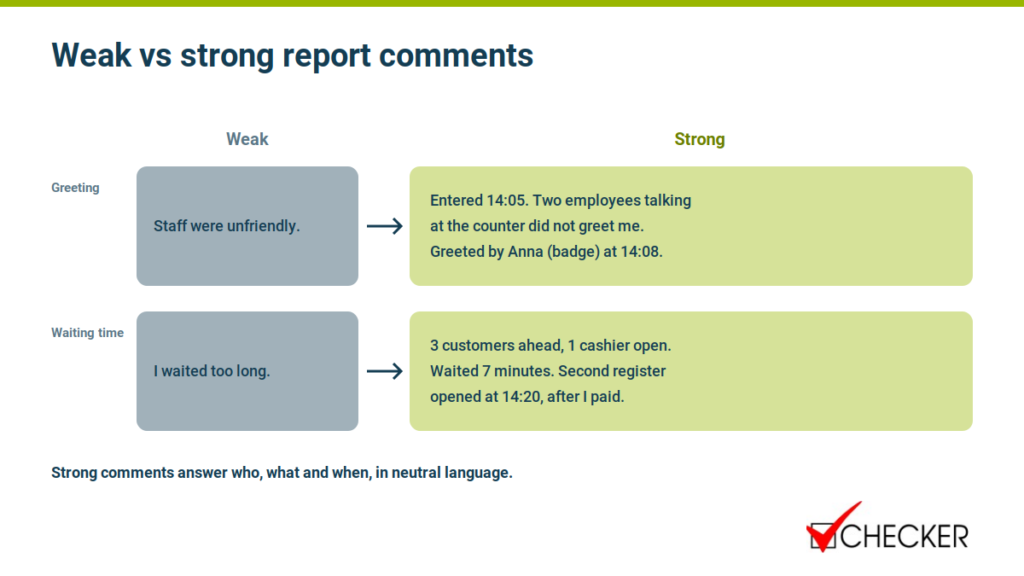
Weak and strong comments compared
| Topic | Weak comment | Strong comment |
|---|---|---|
| Greeting | Staff were unfriendly. | I entered at 14:05. Two employees were talking at the counter; neither looked up or greeted me. I was greeted by Anna (name badge) at 14:08, after I approached the counter. |
| Product knowledge | The salesperson didn’t know much. | When I asked about battery life, Mark said he was not sure and did not check or offer to find out. He correctly explained the difference in storage between the two models. |
| Cleanliness | The store was dirty. | The floor near the fitting rooms had several clothing tags and a paper cup. The rest of the sales floor, the counter and windows were clean. |
| Upselling | She tried to sell me more. | After I chose the jacket, Elena recommended a waterproofing spray, explained it would protect the material, and mentioned the 20% bundle discount. She accepted my “no, thanks” without pressure. |
| Waiting time | I waited too long. | There were three customers ahead of me in a single queue with one cashier. I waited 7 minutes; a second register opened at 14:20, after I had paid. |
| Closing | Good ending. | Anna thanked me by name, handed me the receipt in the bag and said, “Come back and let us know how you get on with it.” |
Five rules for report comments
- Describe, don’t judge. Write what the employee said and did; let the facts carry the conclusion.
- Include who, what, when. Names or descriptions, actions, and times make comments verifiable.
- Support every score. Each “no” or low score needs a comment explaining why, and each “yes” on an important question benefits from one too.
- Be consistent. If you answered “yes” to “Were you greeted within 1 minute?”, your narrative must not say you waited three minutes.
- Stay neutral and professional. Avoid sarcasm, exaggeration and emotional language, even when service was poor.
Mystery shopping tips by channel
Retail stores
Note how long it takes to be acknowledged, whether staff approach you or wait to be asked, and how they discover your needs. Check displays, price labels and fitting rooms if relevant. Keep the receipt; it often proves the time of the visit and the employee who served you.
Restaurants and cafés
Time everything: seating, menu, order, food arrival, check, payment. Note the temperature and presentation of each dish, whether the server checked back after food arrived, and the cleanliness of the restrooms. Order exactly what the brief specifies, and photograph the receipt.
Hotels
A hotel visit can include a reservation call, check-in, the room, facilities, breakfast and check-out. Document the room on arrival before you use it, test requests such as a wake-up call or extra pillows if the scenario asks, and keep track of every interaction and its time.
Banks, car dealerships and other advisory sales
These visits focus on needs discovery, product explanations and compliance. Prepare your profile in detail, because advisers will ask questions about your situation. Note whether costs, risks and conditions were explained, and whether follow-up contact happened as promised.
Phone calls (mystery calling)
Count rings and hold time precisely, note the greeting word for word, and write down names immediately. If recording is part of the assignment and legal, check that it works before the call. Keep a quiet environment so you can concentrate on the conversation.
Online, chat and email
Take screenshots with visible timestamps, note how long each reply took, and whether answers were personal or copied from a script. Test the scenario exactly as written; online interactions are easy to compare, so consistency matters.
Mistakes that get reports rejected
- Visiting outside the required date or time window. Even an excellent report may not be usable.
- Missing proof of visit. No receipt, no photo or an unreadable one.
- Scores and comments that contradict each other. One of the most common reasons editors send reports back.
- Vague or emotional comments. “Terrible service” tells the client nothing they can act on.
- Missing names or descriptions of the employees you dealt with.
- Not following the scenario, such as buying a different product or skipping a required question.
- Copying text between reports. Agencies notice repeated phrasing across visits, and it damages trust.
- Late submission. Reports submitted after the deadline may be rejected or paid at a reduced rate.
- Revealing yourself as a shopper during the visit, which invalidates the evaluation.
Legal and ethical rules every shopper should know
- Recording. Audio and video recording laws differ by country and even by region. Record only when the assignment explicitly requires it and the agency has confirmed it is legal where you are shopping. Never record in places where people expect privacy.
- Photos. Photograph only what the brief asks for, avoid capturing other customers’ faces, and never take photos in restrooms, fitting rooms or changing areas.
- Honesty. Report exactly what happened. Never invent details, estimate times you did not record or complete a report for a visit you did not make. Fabrication is the fastest way to lose access to assignments, and can have legal consequences.
- Confidentiality. Do not share the client’s name, the scenario or the results with anyone, including on social media.
- Fairness to employees. Remember that your report can affect real people’s jobs. Be accurate, balanced and fair, and note positive behavior as carefully as negative.
- Professional standards. Many agencies follow the ethical guidelines of the MSPA (Mystery Shopping Providers Association) in their region. Ask your agency which standards apply.
How to spot mystery shopping scams
Fake mystery shopping offers are a well-known scam. Genuine agencies never ask you to pay to work for them. Be suspicious of any offer that:
- Sends you a check or money transfer and asks you to deposit it, then send part of the money back or buy gift cards. The check will bounce and you will lose the money you sent.
- Asks you to evaluate a money transfer service by sending money to someone.
- Charges a fee for registration, certification, training or a “guaranteed” list of assignments.
- Arrives unsolicited by text, social media or email from someone you have never registered with.
- Promises unusually high pay for very little work.
- Uses free email addresses or cannot give a verifiable company name, address and website.
Genuine mystery shopping agencies let you register for free, publish assignments through their own platform or app, and reimburse purchases after the report is approved. If in doubt, check whether the agency is a member of a recognized industry association and search for independent reviews from other shoppers.
How to choose a reliable mystery shopping agency
The agency you work with shapes your experience as much as the assignments themselves. Signs of a good agency include:
- Free registration and a clear, professional website with a company address and contact details
- Clear guidelines for every assignment, with examples of what is expected
- A proper platform or app for accepting assignments, submitting reports and tracking payments
- Constructive editor feedback that helps you improve, rather than unexplained rejections
- Transparent, prompt payment, with fees and reimbursement terms stated before you accept an assignment
- Membership of an industry association such as the MSPA in your region, and positive independent reviews from other shoppers
Many shoppers register with several agencies to get a steady flow of assignments, then focus on the ones that treat them best.
For businesses: best practices for a mystery shopping program
Shoppers can only deliver useful results if the program behind them is well designed. If you run or commission mystery shopping, these practices make the biggest difference.
Start with clear objectives. Decide what you want to learn and which decisions the results will inform before you write a single question.
Make questions measurable. “Was the staff friendly?” means something different to every shopper. Break it into observable behaviors instead: Did the employee make eye contact and smile? Did they greet you within 30 seconds? Did they give you their full attention during the conversation? Combine yes/no questions with a comment field so shoppers can explain each answer.
Keep the questionnaire manageable. Focus on the behaviors that most affect customer satisfaction and loyalty. A long form leads to tired shoppers and less accurate answers.
Use the right shoppers. Avoid friends, employees’ relatives or regular customers, who tend to be loyal and less objective. Match shoppers to your real customer profile, and use expert shoppers when a question needs professional knowledge.
Don’t chase perfect scores. A program where every location scores 100% has stopped measuring anything useful. Raise the standard, or test different parts of the experience, so the results keep showing where to improve.
Use results to motivate, not to punish. Tell employees the program exists, share results openly, and recognize excellent performance, for example with an employee reward or recognition scheme linked to mystery shopping scores. Programs seen as spying damage morale and performance.
Run it consistently. A single wave is a snapshot. Regular waves with the same core questions show trends and whether improvements last.
Act on the findings. Turn results into coaching, training and process changes with clear owners, then measure again.
For agencies: helping shoppers deliver better reports
Every tip above is easier to follow when the agency makes it easy. The agencies with the best report quality usually do the same few things well.
Clear, visual guidelines. Short instructions with examples of what a pass and a fail look like, and of the comment quality you expect, reduce questions and rework.
A mobile app that guides the visit. Questionnaires shoppers can review offline, timers for waiting times, photo and receipt upload, and GPS check-in all make accurate reports easier and visits verifiable.
Validation built into the form. Required comments for low scores, logic checks between answers, and minimum lengths for narratives catch the most common mistakes before submission.
Fast, specific editor feedback. Shoppers improve fastest when they get clear feedback on each report. AI-assisted review can flag inconsistencies, missing evidence and vague comments as soon as a report arrives, so editors spend their time on coaching rather than checking.
Fair, prompt payment. Paying approved reports on time keeps the best shoppers loyal.
Checker helps mystery shopping agencies manage their shopper community, assign visits, collect reports through a mobile app and review them with AI support, so report quality goes up and turnaround time goes down.
Frequently asked questions
What makes a good mystery shopper?
Attention to detail, a good memory, the ability to stay in character, objectivity, clear writing and reliability with deadlines. Good shoppers also accept editor feedback and use it to improve.
How do I remember everything during a visit?
Prepare by learning the questionnaire in advance, focus on the key facts at each stage of the visit, note times discreetly, and write everything down immediately after you leave. Practice makes it much easier.
Can I take notes or photos during a mystery shop?
Only if the guidelines ask for it, and always discreetly. Most shoppers rely on memory during the visit and write notes straight afterwards.
How long should a mystery shopping report take?
A simple retail visit report may take 20 to 30 minutes; detailed restaurant, hotel or advisory-sales reports can take an hour or more. Complete it as soon as possible after the visit.
Do mystery shoppers get paid?
Yes. Shoppers are typically paid a fee per assignment and reimbursed for required purchases, after the report is approved. Pay depends on the length and complexity of the assignment.
Is mystery shopping legitimate?
Yes. Mystery shopping is a long-established research method used by retailers, banks, hotels, restaurants and many other businesses. Be cautious of scams, though: genuine agencies never ask you to pay or to transfer money.
How do I become a mystery shopper?
Register with established mystery shopping agencies in your country, complete your profile accurately, and start with simple assignments. Excellent reports lead to more, and more varied, assignments.
Conclusion
Effective mystery shopping comes down to preparation, careful observation, discretion and, above all, reports that are factual, specific and fair. Follow these ten secrets and the checklist above, and your evaluations will help businesses improve real customer experiences, while building your reputation as a shopper agencies want to work with.
For mystery shopping agencies: run better programs with Checker. Checker gives agencies a mobile app for shoppers, smart questionnaires with built-in validation, AI-assisted report review and live client dashboards, all on one platform.


