


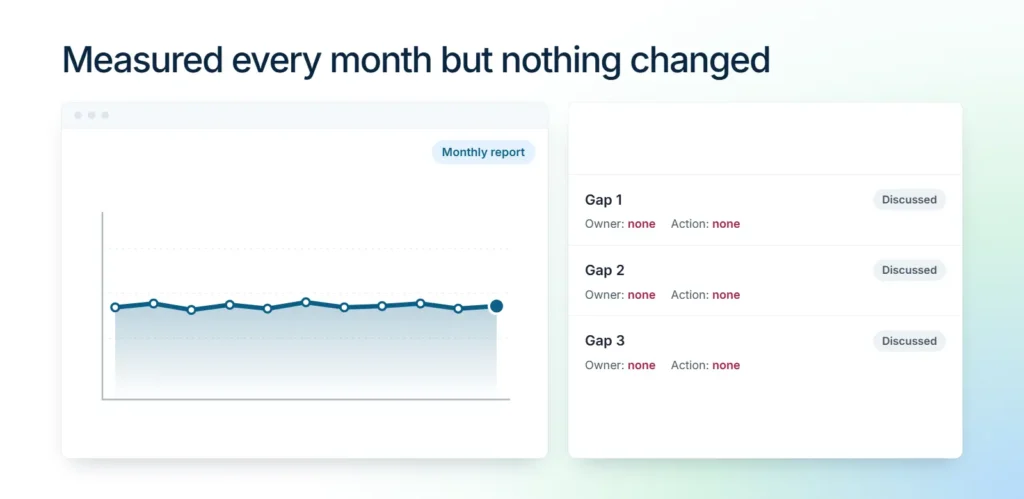
Most brands serious about improving customer experience already measure it. There’s a satisfaction survey after every visit, an NPS question in the app, a dashboard the leadership team looks at every month. And yet the score has barely moved in two years. The same complaints show up in reviews. The same three locations sit at the bottom of the league table every quarter.
That isn’t a measurement problem. It’s what happens when measuring becomes the program. Improving customer experience stalls after the survey because that’s where most programs stop. The improvement happens next, when someone finds the gap behind the score, fixes it at the touchpoint where customers feel it, and checks whether the fix worked.
This playbook walks through that loop step by step. It covers how to combine surveys, mystery shopping and Voice of Customer so you see the full picture, how to pick which gaps to fix first, what real fixes look like, and how to avoid the trap of measuring forever. It’s written for brands running experience across many locations or channels, in retail, banking, hospitality, F&B and automotive.
What does improving customer experience actually mean?
Improving customer experience means closing the gap between what customers expect, what your standards promise, and what actually happens at each touchpoint. In practice it is a repeating loop including measuring the experience, finding the gaps that matter most, fixing them where customers feel them, and re-measuring to confirm the change.
The key word is loop. A one-off survey, a new mission statement or a training day can all help. But on their own, they don’t improve anything for long. Experience drifts. Staff change, processes get shortcuts, a new competitor resets what “good” looks like. So the brands that get better year after year are the ones that run the loop on a regular rhythm, not the ones with the most data.
Why improving customer experience stalls after the survey
Here’s the pattern we see most often. A brand launches a survey program with real energy. Scores start coming in, and a dashboard goes up. Then the monthly review turns into a reporting meeting. Everyone looks at the numbers, someone explains why this month’s dip was the weather, and the meeting ends with no owner and no action.
Three things usually sit behind it.
- One data source gets asked to do every job. A survey tells you how customers feel. It can’t tell you whether your staff followed the greeting standard, or why a branch’s score fell.
- Nobody owns the gap. Scores land in head office. The people who can fix the problem, store and branch managers, see a monthly PDF or nothing at all.
- Reporting is the finish line. The program counts success in surveys sent and responses collected. Nobody counts fixes made.
The cost isn’t only wasted research budget. It’s worse. Customers who took the time to give feedback and saw nothing change, stop giving it. The ones who don’t complain simply stop coming back. Harvard Business Review reports that winning a new customer costs five to 25 times more than keeping an existing one (Amy Gallo, “The Value of Keeping the Right Customers,” 2014).
Every unfixed gap gets paid for twice, once in research and once in lost customers.
The fix is to treat the survey as step one of a loop, not the finish line. Here’s how that loop works.
The measure-and-improve loop in four steps
The loop has four steps. Each one has a clear output, so you can tell whether it actually happened.
| Step | What you do | Output that proves it happened |
|---|---|---|
| 1. Measure | Collect experience data from surveys, mystery shopping and VoC | A combined view of each location and touchpoint |
| 2. Find the gaps | Compare what customers say with what actually happened | A short, ranked list of gaps with an owner for each |
| 3. Fix | Change the process, standard, training or product at the touchpoint | A written action, a named owner and a date |
| 4. Re-measure | Repeat the same measurement after the fix | A before and after comparison |
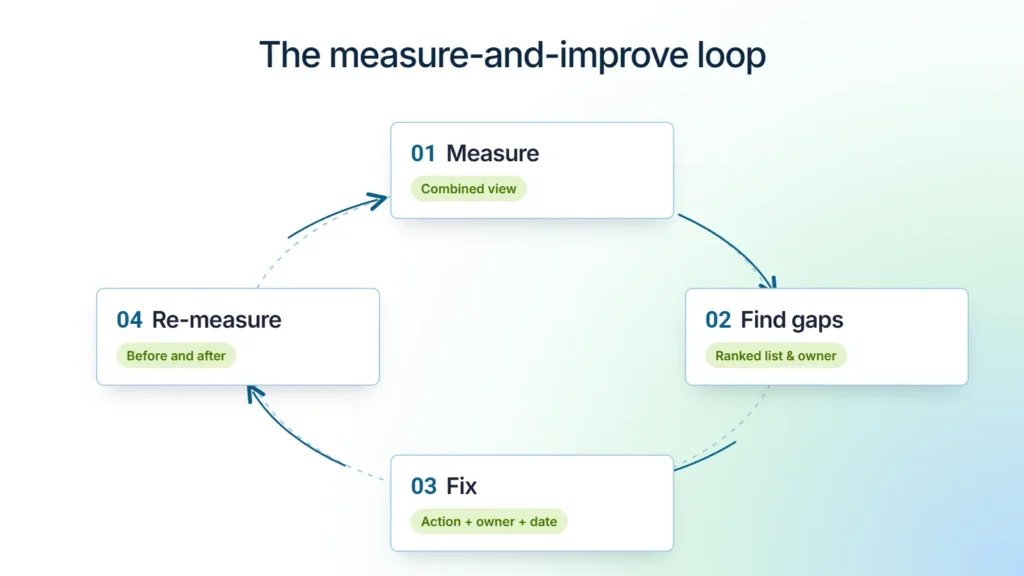
Then the loop starts again. The rest of this guide takes each step in turn.
Step 1: Measure the experience from three angles
No single method sees the whole experience. Each one answers a different question, and each one has a blind spot. So the strongest programs combine them.
Surveys tell you what customers think
Post-visit and post-purchase surveys capture opinion: satisfaction, effort, likelihood to recommend. CSAT, NPS and CES all sit here. They’re good for tracking perception over time and comparing locations at scale.
However, their blind spot is the cause. A low score tells you a customer was unhappy. It rarely tells you what went wrong, and customers tend to rate how they felt, not what happened. Response bias matters too, since the very happy and the very angry answer most often.
Mystery shopping tells you whether standards are met
Mystery shopping sends trained evaluators through the real customer journey, in person, by phone or online, to check what actually happens. Were they greeted within a set time? Did the advisor explain the fees? Was the fitting room clean? Did the agent offer a follow-up?
In other words, this is your view of delivery, not opinion. It shows whether each location follows the standards you set, and it’s the most reliable way to compare sites fairly. Its blind spot is perception. A branch can hit every standard on the checklist and still frustrate customers, because the standard itself was the wrong one. We’ll come back to that.
Voice of Customer catches the signals you didn’t ask about
Voice of Customer (VoC) pulls in what customers say in their own words, wherever they say it. That includes open-text survey answers, reviews, complaints, contact center notes and social comments. As a result, it surfaces issues you never thought to ask about, like a confusing new app screen or a recurring parking problem at one store.
Still, its blind spot is volume and noise. Thousands of comments need reading, grouping and routing before they turn into anything useful. That’s where AI text analysis now earns its keep, as long as a person still checks what it finds.
How the three sources fit together
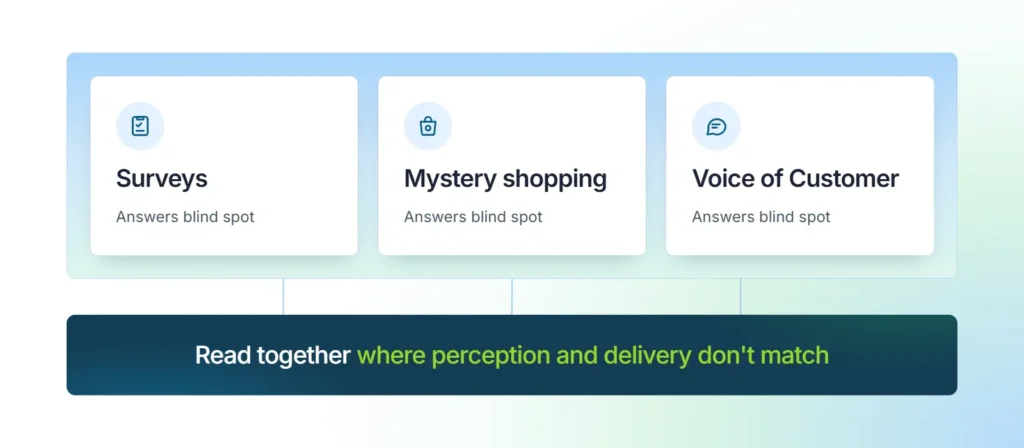
| Source | Answers | Blind spot | Typical rhythm |
|---|---|---|---|
| Surveys | How do customers feel? | Why they feel that way | Continuous, after each interaction |
| Mystery shopping | Do we deliver our standards? | Whether the standards are the right ones | Monthly or quarterly waves per location |
| Voice of Customer | What are customers telling us unprompted? | Volume, noise, no structure | Continuous |
Put together, they answer the question no single source can. Customers are unhappy, our standards say we did everything right, so where exactly is the gap?
Step 2: Find the gaps that matter most
This is the step most programs skip, and it’s where improving customer experience is usually won or lost. Data from three sources only helps if you read them against each other. A simple way to do it is to compare delivery (mystery shopping) with perception (surveys and VoC) for each location or touchpoint.
| Customers happy | Customers unhappy | |
| Standard delivered | Protect it. Share what this site does well. | The standard is wrong. Rethink what “good” means here. |
| Standard missed | Hidden risk. You’re getting away with it, for now. | Fix first. Clear failure, clear cause. |
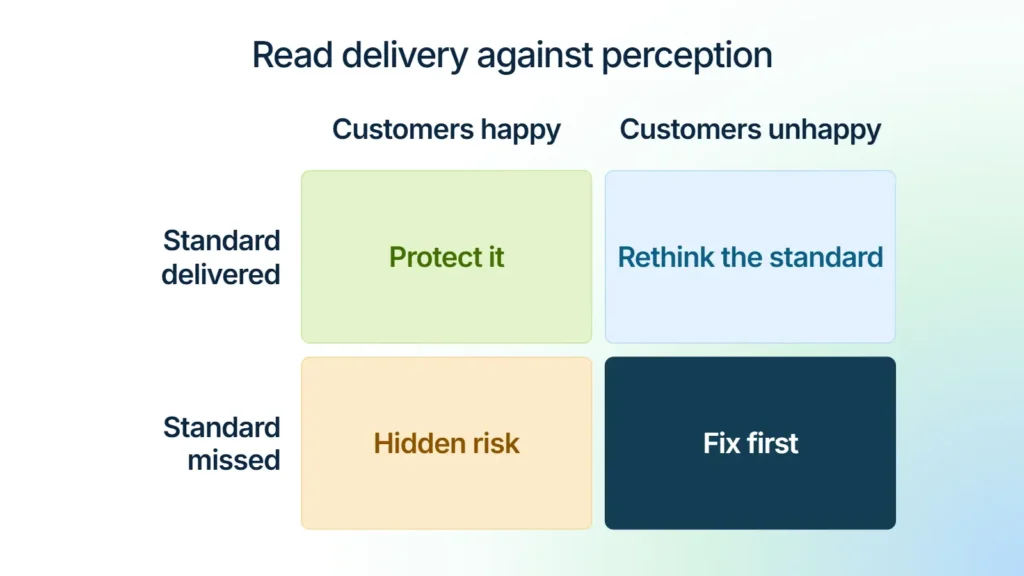
The bottom-right box is obvious. By contrast, the top-right box is the one most brands miss, because every internal report says the location is compliant. That’s exactly the situation in the airport story in Step 3.
Next, rank the gaps. You’ll find more than you can fix at once, so score each one on three questions:
- How many customers does it touch? A checkout problem at every store beats a one-off issue at one site.
- How much does it hurt? Weigh it against what you know drives repeat visits, complaints and churn in your business.
- How hard is the fix? Some fixes are a staff briefing, while others are a capital project.
Then pick a short list, three to five gaps per cycle, and give each one a named owner. Also look for outliers, not only averages, because improving customer experience at the weakest sites usually moves the overall score fastest. A national score can look fine while a handful of locations drag down everything around them. Location-level mystery shopping and VoC make those outliers visible.
Step 3: Fix the experience at the touchpoint
In practice, a fix is a change customers would notice. A new KPI, a memo or another survey question doesn’t count. Two well-documented cases show what that looks like, and why the right fix isn’t always the obvious one.
When hitting the target didn’t stop the complaints
The New York Times tells the story of a Houston airport flooded with complaints about waiting at baggage claim (Alex Stone, “Why Waiting in Line Is Torture,” 2012). In response, it added baggage handlers. Average waits fell to eight minutes, within industry benchmarks, yet the complaints kept coming.
So managers went and looked at the journey on site. Passengers walked about one minute to the carousel, then stood there for around seven more. Most of their time was spent idle. The airport moved arrivals further from the main terminal and sent bags to the outermost carousel. The walk took six times longer, and complaints dropped to near zero.
For any brand, the lesson is direct. The airport met its operational standard, and customers were still unhappy. Only first-hand observation of the real journey found the actual gap, which was idle waiting, not total time. That’s the top-right box from Step 2, and it’s what mystery shopping is designed to catch.
When customers say the product itself is the problem
Sometimes the feedback points past service to the product. In late 2009, Domino’s publicly acknowledged harsh customer criticism of its pizza and relaunched with a new recipe, in a campaign it called the “Pizza Turnaround.” It aired the criticism openly rather than hiding it.
That said, the point here isn’t to copy the advertising. It’s that the company treated recurring complaints as a brief for change, not as noise to explain away. That’s the job VoC should do for every brand. When the same complaint keeps coming back, it’s telling you what to fix.
What fixes look like at common touchpoints
The table below shows typical gaps at the touchpoints brands measure most, how each one usually surfaces, and the kind of fix that tends to work. Treat these as starting points. Your own data decides which ones apply to you.
| Touchpoint | Typical gap | How it usually surfaces | Fix that tends to work |
|---|---|---|---|
| Bank branch, account opening | Advisors skip the fee explanation when queues build up | Mystery shopping shows it missed at busy times; complaints follow later | Shorter, mandatory disclosure script; adjust staffing to queue peaks |
| Retail store, fitting room and checkout | Standards slip at weekends and in the evening | Mystery shopping by day and time slot; VoC mentions “no one around” | Rota changes at peak hours; a simple staff checklist |
| Hotel check-in | Fast check-in, but no information about the stay | Survey scores dip; comments ask about breakfast or Wi-Fi | Add two information steps to the script; print a one-page guide |
| Contact center | Issue “resolved” on the call but not actually fixed | Repeat calls in VoC; low effort scores | Measure first-contact resolution; give agents authority to finish the job |
| Car dealership, test drive | Follow-up never happens after a visit | Mystery shopping tracks follow-up within a set number of days | Automated follow-up reminders in the CRM; tie it to the sales review |
| Website or app checkout | A new step confuses customers | Open-text spikes after a release; survey drop-offs | Roll back or simplify the step; test with real users before release |
Two rules make fixes stick. First, every fix has a named owner and a date, written down where the whole team can see it. Second, the person closest to the touchpoint, usually the location manager, gets the data for their own site. A store manager who sees their own mystery shopping report and customer comments the same week can act. One who gets a national average a month later can’t.
Step 4: Re-measure and close the loop
Re-measuring is how you know a fix worked, rather than hoping it did. It’s also the step that turns improving customer experience from a project into a habit.
Keep it simple and consistent:
- Use the same method and questions. If you change the survey or the mystery shopping checklist at the same time as the fix, you can’t tell what caused the change.
- Give the fix time to land. Re-measure after the change has bedded in, typically the next mystery shopping wave or a few weeks of survey data, not the day after.
- Compare like with like. Check the same location, the same time slot and the same touchpoint as the original gap.
- Tell people what changed. Tell staff what improved and why. Where you can, tell customers too, for example with a reply to a review or a note in the next survey. People keep giving feedback when they can see it leads somewhere.
When the gap closes, lock in the new standard and move to the next item on the list. If it didn’t, you’ve learned the fix was wrong, which is still progress. Go back to Step 2 with the new data.
How to stop measuring endlessly and start acting
This trap deserves its own section, because it’s the one that quietly kills CX programs. The warning signs are familiar. Monthly reports nobody reads to the end. A survey that grows by a few questions every year. A dashboard with forty KPIs and no owners.
So set a few rules that keep the program honest:
- Every metric has an owner and a threshold. If a number drops below an agreed level, a named person acts. If nobody would act on a metric, stop reporting it.
- Every survey question links to a decision. Before adding a question, write down what you’d do differently depending on the answer. If you can’t, leave it out. Shorter surveys also get more responses.
- Track fixes, not just scores. Count how many gaps you found, fixed and confirmed this quarter. It’s the clearest signal of whether the loop is actually turning.
- Route alerts, don’t batch them. A serious complaint or a failed compliance check should reach the right manager the same day, not wait for the monthly pack.
- Cut the review meeting down to decisions. Spend five minutes on the numbers and the rest on which gaps to fix, who owns them, and what got done since last time.
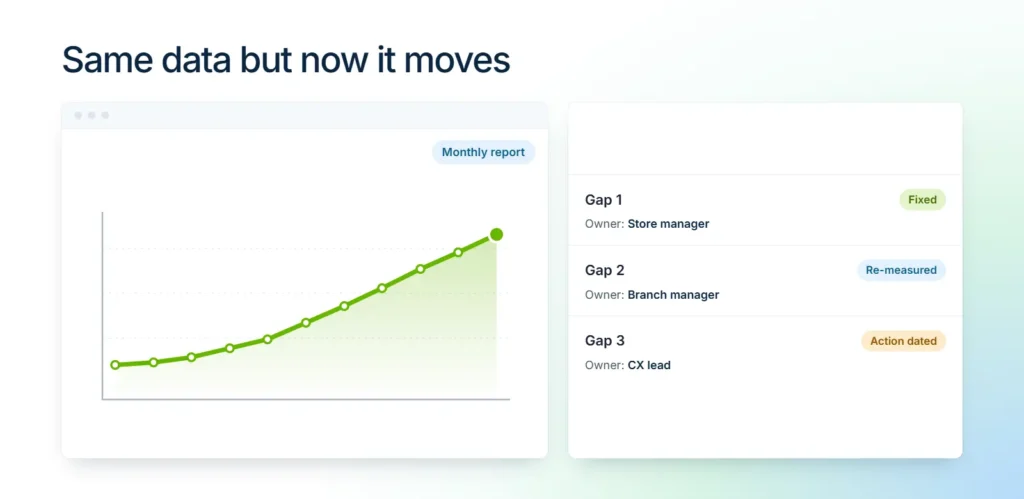
A useful test: if your CX program stopped tomorrow, would anything in the customer’s experience change in the next quarter? If the honest answer is no, you have a reporting program, not an improvement program.
What you need in place to run the loop
You don’t need a large CX team for improving customer experience this way. You do need the plumbing that lets data move from customers to the people who can act, without someone rebuilding it by hand every month.
- All three sources in one place. When surveys, mystery shopping and VoC sit in separate tools, nobody compares them, and Step 2 never happens.
- Role-based, real-time dashboards. Each manager sees their own locations and touchpoints as soon as data lands, not a national average weeks later.
- Reliable field data collection. Mystery shoppers and auditors need a mobile app that works offline, so a long store or hotel evaluation isn’t lost on weak Wi-Fi.
- Automated ingestion and alerts. Data from POS, CRM, review sites and call logs flows in without manual exports, and urgent issues trigger alerts.
- Action tracking. Somewhere to log each gap, its owner, the fix and the re-measure result.
- Privacy by design. Customer feedback is personal data. In Europe, GDPR-grade handling is a requirement, and something your own customers increasingly expect.
An honest trade-off is a single-site business can run a basic version of this loop with a survey tool and a spreadsheet. It’s a fine place to start. But once you’re comparing many locations across several data sources, spreadsheets start to break. Data gets copied by hand, versions drift, and the people who need the numbers get them too late to act. That’s usually the point where a dedicated platform pays for itself in hours saved and gaps fixed sooner.
Common mistakes to avoid
- Relying on one data source. Surveys alone can’t explain causes, and mystery shopping alone can’t measure feeling. You need both, plus VoC.
- Fixing the average, not the outliers. A healthy national score can hide a few failing locations. Look at site-level data.
- Measuring the wrong standard. Hitting an internal target that customers don’t care about wastes effort. The airport proved it.
- Changing everything at once. If you fix five things in one week, you won’t know which one worked.
- Keeping data at head office. The people who can fix the gap need to see it, quickly and for their own site.
- Treating the report as the result. The result is a changed experience, confirmed by re-measurement.
From measuring to improving
Measuring customer experience is easy to start and easy to get stuck in. Improving customer experience is the harder, more valuable part. The brands that actually get better treat measurement as the first step of a loop, not the end of one. They combine opinion, delivery and unprompted feedback. They find the specific gaps behind the score, fix them where customers feel them, and check the result.
That’s the loop Checker helps brands run. Mystery shopping, CX surveys and Voice of Customer sit on one platform, with real-time, role-based dashboards that give every location manager their own data and a fully offline mobile app for field evaluations. Behind it are more than 20 years of running programs across 60 countries.
Build your measure-and-improve loop. Book a free consultation. We’ll look at what you measure today, where the gaps between your data sources are, and how to turn your next round of results into fixes.
Frequently asked questions
The most reliable approach is a repeating loop. Measure the experience from several angles, find the gaps that matter most, fix them at the touchpoint, and re-measure to confirm the change. Combining surveys (opinion), mystery shopping (delivery against standards) and Voice of Customer (unprompted feedback) shows both what’s going wrong and why.
Use more than one method. Surveys such as CSAT, NPS and CES track how customers feel. Mystery shopping checks whether each location delivers your service standards. Voice of Customer analysis captures what customers say unprompted in reviews, complaints and open-text answers. Reading them together shows where perception and delivery don’t match.
Mystery shopping shows what actually happens at each touchpoint, measured against your own standards, location by location. It finds problems surveys can’t explain, such as a missed greeting or a skipped disclosure, and it shows whether a fix has been adopted on the floor. It’s also the fairest way to compare sites, since every evaluator follows the same scenario.
Surveys and VoC run continuously. Mystery shopping usually runs in monthly or quarterly waves per location. What matters more than frequency is rhythm. Every measurement cycle should end with a short list of gaps, owners and fixes, then a re-measure to check what changed.
Most fail because measurement becomes the goal. Scores get reported but nobody owns the gaps, data stays at head office instead of reaching location managers, and success is counted in surveys sent rather than fixes made. Customers notice when their feedback leads nowhere, and they stop giving it.
Simple fixes, like a staffing change or a script update, can show up in the next mystery shopping wave or a few weeks of survey data. Bigger changes to a process or product take longer. Either way, re-measure each fix with the same method so you can see real movement instead of noise.


