


If you run research programs for a living, you already know the software is rarely the exciting part. It’s the thing that either quietly moves your data from the field to a client-ready report, or the thing that eats your team’s week with manual exports, broken spreadsheets, and dashboards that lag a day behind reality.
This guide is about getting that decision right. We’ll cover what market research software actually is, the main types on the market, the features that separate a modern platform from a legacy one, and a practical process for choosing, whether you’re a brand running programs in-house or an agency delivering insight to clients.
A quick note on where this comes from: Checker has spent 20+ years running mystery shopping and customer experience research across 60 countries, and 15+ years building the technology behind it. So this isn’t a generic listicle. It’s the buying logic we’ve watched play out in real deals, written for the people who have to live with the platform after the contract is signed.
What is market research software?
Market research software is the technology that manages the full research lifecycle, designing studies, collecting data across channels, cleaning and quality-checking responses, analyzing results, and reporting them to the people who act on them. In practice it replaces the patchwork of survey tools, spreadsheets, email threads, and manual scoring that most research still runs on.
The term is broad on purpose. Under the same umbrella, you’ll find lightweight survey builders, enterprise customer experience (CX) suites, panel-management systems, retail and mystery shopping platforms, and analytics tools. What they share is a job: turn questions asked in the field into decisions made in a boardroom, with as little friction and as few errors as possible in between.
For most buyers, the real question isn’t “do we need software?”, it’s “how much of the lifecycle should one platform own, and where does stitching multiple tools together start to cost more than it saves?”
The market research lifecycle, and where software fits
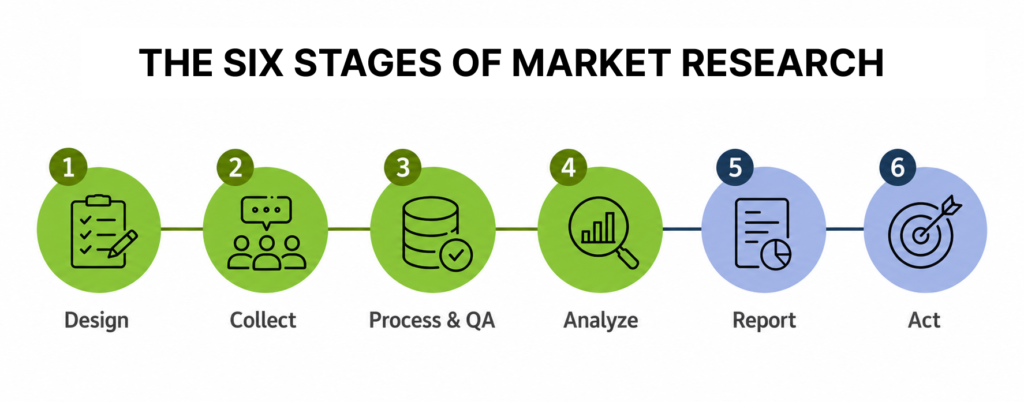
Every research program, from a quick CSAT pulse to a multi-country mystery shopping wave, moves through the same six stages. Understanding them makes it obvious where software earns its keep.
- Design: Building the questionnaire or assessment, defining the sample, setting quotas and logic.
Software role: question libraries, branching logic, reusable templates, multi-language versions.
- Collect: Getting responses from real people in real settings, online, on the phone, in-store, or on a mobile app.
Software role: multi-mode distribution, offline capture, shopper or interviewer management.
- Process & QA: Cleaning data, removing bad responses, scoring assessments, checking coherence.
Software role: automated validation, AI quality checks, penalty/bonus scoring rules.
- Analyse: Finding the patterns: trends, benchmarks, segment differences, drivers of satisfaction.
Software role: cross-tabs, dashboards, statistical and text analytics.
- Report: Packaging insight for stakeholders and clients.
Software role: real-time dashboards, role-based views, exportable and white-label reports.
- Act: Closing the loop: alerts, action plans, follow-up.
Software role: case management, notifications, integrations into CRM and BI.
The stages most buyers underinvest in are collect, process & QA, and report. Those are exactly where manual work quietly piles up. A modern platform’s value is measured less by how pretty the survey builder is and more by how much human effort it removes from those three stages.
The main types of market research software
There’s no single “market research platform” category. There are several, and most tool sprawl comes from buying the wrong type for the job. Here’s how the landscape actually breaks down.
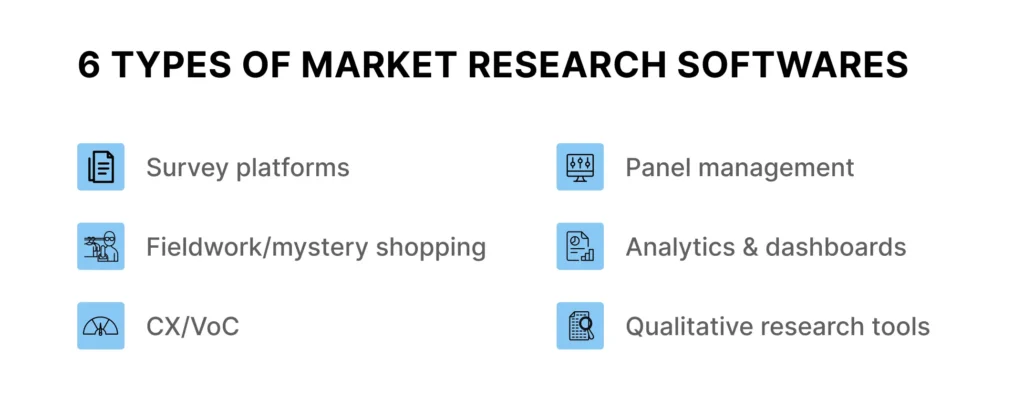
1. Survey and questionnaire platforms
The most familiar category, tools for building and distributing surveys online. Strong for quick quantitative studies and NPS/CSAT pulses. Weaker when you need field data collection, complex scoring, or client-ready program management. Often the starting point that teams later outgrow.
2. Data collection and fieldwork management
Software built for research that happens in the world, not just in an inbox: mystery shopping software, retail audit software, in-store and face-to-face interviewing. This is where shopper recruitment, scheduling, mobile capture, and assessment scoring live. Offline reliability and field-team management matter far more here than in a pure survey tool.
3. Customer experience (CX) and Voice-of-Customer (VoC) platforms
Continuous programs rather than one-off studies, tracking experience across touchpoints, triggering surveys after interactions, and routing feedback to the right team. VoC software and customer experience management tools sit here. The emphasis is on always-on measurement and closing the loop.
4. Panel and respondent management
Systems for recruiting, profiling, incentivising, and retaining the people who take part in research. Critical for agencies running their own communities; less relevant for brands measuring their own customers.
5. Analytics, dashboards, and reporting
The “last mile” layer, turning collected data into visualizations and insights. Some are standalone BI tools. Increasingly this capability is baked into the collection platform so reporting is real-time rather than a separate export-and-rebuild step.
6. Qualitative research tools
Video interviews, online communities, transcription, and increasingly AI-assisted analysis of open-ended and conversational data.
All-in-one vs best-of-breed
The eternal trade-off. Point solutions win on depth in one area but leave you integrating (and reconciling) multiple tools. All-in-one platforms win on a single source of truth, one learning curve, and fewer handoffs, which matters enormously when your data has to move from the field to a client dashboard without human re-keying. For programs that combine mystery shopping, CX, and survey work, an integrated platform usually wins on total cost of ownership even if any single module isn’t the deepest on the market.
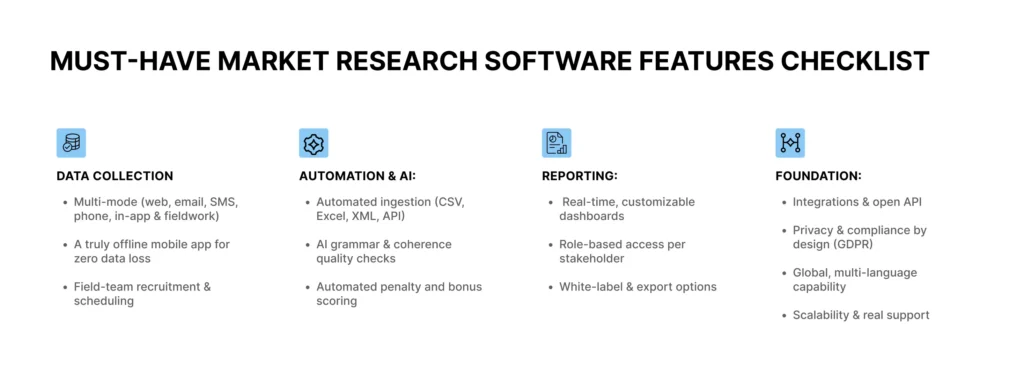
Market research software must-have features
Marketing pages all sound the same. Here’s what actually differentiates a platform once you’re using it daily. Score any tool you’re evaluating against this list.
Data collection
- Multi-mode collection, web, email, SMS, phone, in-app, and field/in-person from one engine, so a single program can mix channels.
- A truly offline mobile app, responses stored locally on the device and synced later. This is not a nice-to-have. Field teams lose long assessments on weak Wi-Fi constantly, and re-entering a 200-question hotel audit is exactly how you lose good shoppers and clean data.
- Field-team management, recruitment, scheduling, and communication for shoppers, auditors, or interviewers.
Automation and AI
- Automated data ingestion, import via CSV, Excel, XML, API, and direct connectors so data flows in without manual handling.
- AI quality control, automatic grammar and coherence checks on open-ended responses, so QA doesn’t mean a human reading every submission.
- Automated scoring, penalty/bonus rules and assessment scoring applied instantly and consistently, not calculated in a spreadsheet.
Reporting
- Real-time, customizable dashboards, results visible the moment data lands, configurable per audience, not a static PDF that’s already stale.
- Role-based access, each stakeholder or department sees only the data relevant to them. Critical for agencies giving clients a portal, and for brands where regional managers shouldn’t see head-office views.
- White-label and export options, client-ready output without rebuilding it by hand.
Foundation
- Integrations and open API, so the platform feeds your CRM, BI, and other systems instead of becoming another silo.
- Privacy and compliance by design, GDPR-grade data handling. In Europe especially, this is a selling point to your clients, not a footnote.
- Global capability, multi-language, multi-currency, and a field network if you collect data across markets.
- Scalability and support, can it handle your biggest program, and is there a real team behind it when a wave goes live at 6 am in another time zone?
If a platform can’t clear the automation, offline, and real-time reporting items, you’re most likely looking at a legacy tool, and you’ll pay for the gap in staff hours every single month.
Market research software for Brands and agencies
It’s the same software but doing two different jobs.
The features above matter to everyone, but the reason they matter splits along who you are.
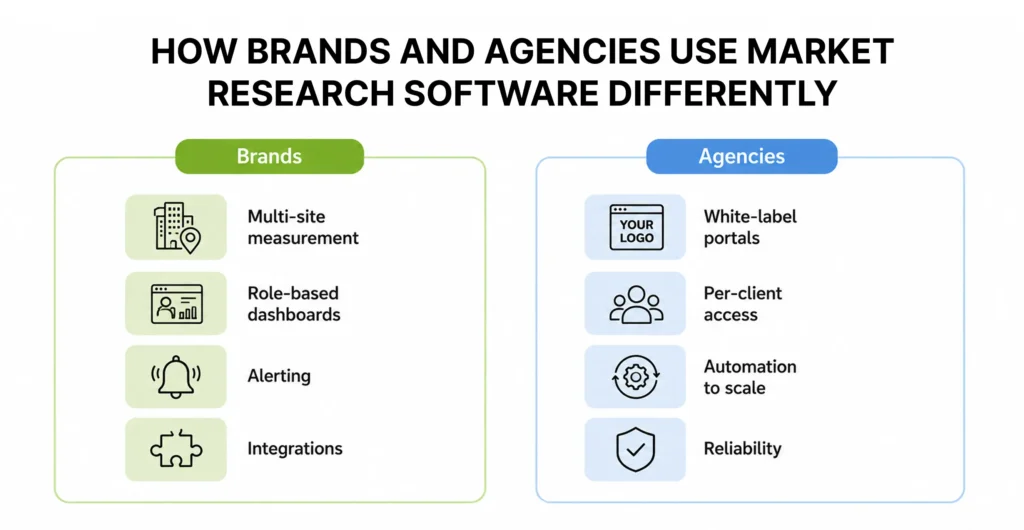
If you’re a brand (retail, hospitality, banking, F&B, automotive, anyone running multi-site operations), market research software is an operations tool. You’re measuring your own locations, employees, and customers continuously, and you need the results to reach the managers who can fix things. Your priorities are multi-touchpoint measurement, role-based dashboards so each site sees its own numbers, alerting that closes the loop, and integrations into the systems your ops teams already use.
If you’re an agency, whether a mystery shopping specialist or a market research firm expanding into MS and CX, the software is your delivery capability. It’s what you put in front of clients, and its limitations become your limitations. Your priorities: white-label client portals, granular access so each client sees only their programs, automation that lets a small team run more projects without more headcount, and reliability that protects your reputation when a client is watching the dashboard live.
There’s also a third audience worth naming: market research agencies that want to add mystery shopping or CX to their offer without building a platform from scratch. For them, the buying question is less “which features” and more “can we launch a new service line in weeks on someone else’s infrastructure?”, which brings us to the next decision.
Build, buy, or partner a market research platform
Three routes to research capability, and the right answer depends on how core the technology is to your business.
- Build: Develop your own platform. Only makes sense if research technology is your product and you have the engineering resources to maintain it for years. For almost everyone else, the ongoing cost of ownership dwarfs the license fee you were trying to avoid.
- Buy: License an existing platform. Fast, predictable, and someone else handles maintenance, security, and new features. The mainstream choice for brands and most agencies.
- Partner: Use a provider’s platform (and sometimes their field network) to deliver a service you couldn’t offer alone. This is how a market research agency adds mystery shopping in weeks instead of years. The platform, shopper network, and know-how come as a package, and you focus on the client relationship and insight.
A useful test: if a capability is a differentiator you’ll invest in for a decade, consider building. If it’s table stakes you need to be excellent at but won’t out-engineer a specialist on, buy or partner.
How to evaluate and shortlist market research softwares
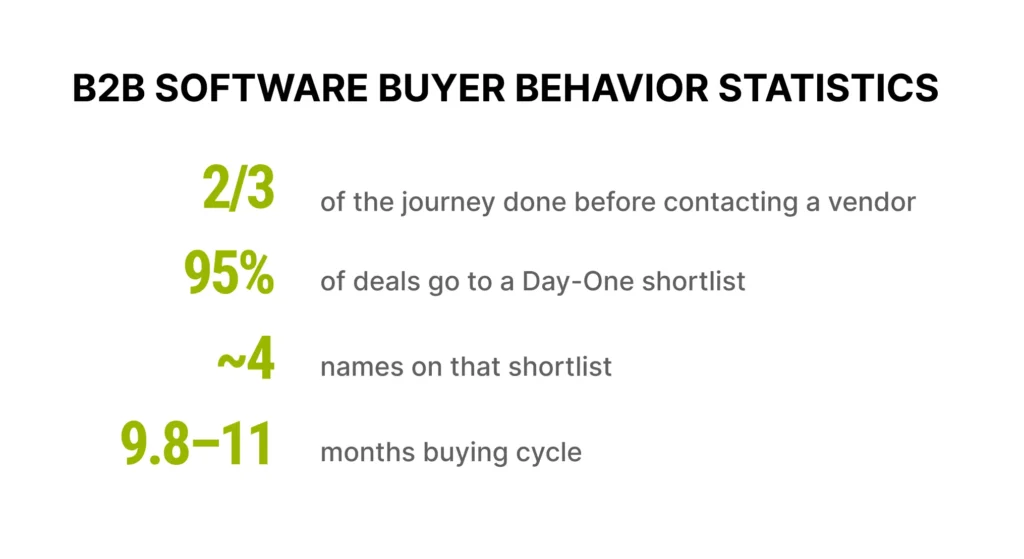
Here’s an uncomfortable but well-documented fact about B2B buying: research from 6sense shows roughly two-thirds of the buying journey is complete before a buyer ever talks to a vendor, and about 95% of deals go to a vendor that was already on the buyer’s Day-One shortlist, a list that’s usually only about four names long. That means your shortlist is doing most of the deciding. Build it carefully.
A practical process:
- Write down the pain, not the feature. “Reporting lags a day behind operations” is a requirement. “Nice dashboards” is not. List the specific manual tasks and failures you want gone.
- Score against the checklist above. Weight the items that map to your pain. Be ruthless about the automation, offline, and real-time items, that’s where legacy tools quietly fail.
- Test with your real data and your real program. A demo on the vendor’s sample data proves nothing. Ask to run a slice of your questionnaire, your scoring, your import files.
- Interrogate the total cost, not the license. A cheaper tool that needs two people re-keying data is not cheaper (more on this below).
- Check the roadmap and the team. Especially for AI features, is it shipped and working, or a slide? Is there support in your time zone when a wave goes live?
Red flags to disqualify quickly: dashboards that only update in batches; no genuine offline mode; “AI” that’s a buzzword with nothing behind it; every department forced to see the same undifferentiated report; a platform visibly unchanged since 2020; and vague answers on data privacy. Buyers currently on ageing platforms cite exactly these, outdated dashboards, heavy manual workarounds, data lost on weak connections, as the reasons they’re switching.
What market research software costs
Pricing in this category is rarely a public number, because programs vary so much. But the models are predictable:
- Per-response or per-completed-survey: common for survey-led tools, costs scale with volume.
- Per-seat or per-user: you pay for the people configuring and reading the platform.
- Per-program or per-location: common for mystery shopping and multi-site CX, priced to the scope of work.
- Platform license and services: a base fee plus setup, custom development, or managed delivery.
The number that actually matters is total cost of ownership, and the biggest line in it is usually invisible on the quote, staff hours. A platform that requires manual questionnaire programming, manual data ingestion in mixed formats, and manual assessment scoring can quietly cost more in salaries every month than a more capable platform costs in license. When you compare, price the workarounds a cheaper tool forces on you, and put a number on the risk of lost or late data. That’s the honest comparison.
Two practical tips: ask every vendor for clear, comparable pricing up front (buyers repeatedly tell us opaque pricing is a frustration), and ask what’s included versus billed as “custom”, setup, extra dashboards, and integrations are common places for the number to move after signature.
Switching platforms and implementing without the pain
Most buyers of market research software aren’t buying for the first time. They’re escaping something. That makes migration, not initial setup, the real risk.
A sane migration plan looks like:
- Audit what you have (questionnaires, historical data, integrations, user roles).
- Map it to the new platform before you sign, not after.
- Run one program in parallel on both old and new so you can compare outputs and build confidence.
- Then cut over program by program rather than all at once.
- Ask any vendor directly how they handle historical data import and how long a realistic go-live takes for a program like yours.
The good news: a modern platform with automated ingestion and reusable templates typically goes live in weeks, not the many months legacy implementations became known for. If a vendor quotes you a multi-quarter setup for a standard program, that’s information about the platform.
Where the market is heading in 2026
Five shifts worth building your decision around:
AI that saves real hours, not AI as a slogan. The credible use of AI in research right now is unglamorous and valuable. Automatic grammar and coherence checks on open responses, automated penalty or bonus scoring, faster analysis of open-ended and conversational data. Notably, in B2B buying research, roughly 90% of European buyers say AI features were part of the solutions they acquired, buyers now expect it. Judge AI claims by the hours they remove, not the vocabulary they use.
Offline-first data collection. As more research moves to mobile and into places with unreliable connectivity, hotels, transit, rural retail, the platforms that store responses locally and sync later have a hard, practical edge. This is a quiet dividing line between modern and legacy tools.
Real-time everything. Stakeholders and clients increasingly expect to watch results land live. Batch reporting is becoming a disqualifier.
Privacy as a feature. With GDPR strictly enforced in Europe and similar regimes spreading, privacy-first data collection is something you actively sell to clients, not a compliance checkbox.
Discovery is changing, including AI answers. Buyers now find and vet vendors through search, word of mouth, and generative AI answers. For providers, that means the content and clarity of your public information increasingly determines whether you make that four-name shortlist, before any conversation happens.
Common mistakes to avoid
- Buying for the demo, not the daily grind. The impressive survey builder isn’t where your team will spend its time. The unglamorous collect–QA–report loop is.
- Underrating offline and automation. These feel like edge cases in a demo and become daily costs in production.
- Treating price as the license fee. The manual workarounds a cheaper tool forces are the real bill.
- Over-buying. A brand measuring its own customers doesn’t need a full panel-management suite. Match the type to the job.
- Ignoring change management. The best platform fails if no one adopts it. Weigh ease of learning and quality of support.
- Skipping the real-data test. Sample-data demos hide exactly the friction you’re trying to escape.
Turning fieldwork into insight with less manual work
If there’s one theme across everything above, it’s that the best market research software isn’t the one with the longest feature list. It’s the one that removes the most human effort between a response in the field and a decision in a report, without losing data or lagging behind reality.
That’s the problem Checker was built to solve: an AI-driven, end-to-end platform for mystery shopping, CX, and VoC programs, with automated ingestion and scoring, a fully offline mobile app, real-time role-based dashboards, and 20+ years of global field experience behind it, built by a team that develops its own technology, so the platform bends to your program rather than the other way around.
See it on your own program. Book a free platform demo and bring a slice of your real questionnaire and data, we’ll show you exactly how much of the manual work disappears.
FAQ
It manages the full research lifecycle, designing studies, collecting data across channels (online, phone, in-store, mobile), cleaning and quality-checking responses, analyzing results, and reporting them to decision-makers. It replaces the mix of survey tools, spreadsheets, and manual scoring that most research otherwise runs on.
Survey software is one category within market research software, focused on building and distributing online questionnaires. Market research software is broader, it also covers field data collection, mystery shopping and retail audits, CX/VoC programs, respondent management, and real-time reporting. If you only need online surveys, a survey tool may be enough; if you run programs in the field or deliver insight to clients, you’ll usually outgrow it.
It depends on how much of the lifecycle you run. Specialized tools offer depth in one area but leave you integrating and reconciling data across them. All-in-one platforms give you one source of truth and no manual handoffs, which matters most when data has to move from the field to a client dashboard without re-keying. For combined mystery shopping, CX, and survey work, an integrated platform usually wins on total cost.
Pricing follows a few models, per response, per user, per program or location, or a platform license plus services, and is usually quoted to your scope rather than published. The figure that matters is total cost of ownership, where the largest and least visible line is the staff hours a platform does or doesn’t save through automation.
A modern platform with automated data import and reusable templates typically goes live in weeks. The bigger risk is migration, not setup, map your existing questionnaires, data, and integrations before you sign, and run one program in parallel on both systems before cutting over.
White-label client portals, granular role-based access so each client sees only their own programs, automation that lets a small team run more projects without more headcount, and the reliability to protect your reputation when clients watch dashboards live. If you’re a market research agency adding mystery shopping, prioritize a platform (and ideally a field network) that lets you launch a new service line in weeks rather than build one.


