

In-House Mystery Shopping Software vs a Platform | Checker
Your developer has just handed in their notice. Five years ago they built your in-house mystery shopping software, and nobody else really knows how the scoring logic works. The same week, a new client sends over a 60-question security questionnaire and wants it back by Friday.
We hear versions of this story a lot. Many agencies and brand CX teams start with a tool they built themselves, and plenty of them run it well for years. Then the program grows, the client list grows, and the tool that used to be an advantage becomes the thing everyone worries about.
This guide is for teams on the fence. It covers when building your own mystery shopping software is a good idea, where homegrown tools tend to break, what they really cost, and how to score your own situation. Checker has run mystery shopping and CX programs for more than 20 years in 60 countries, and we build our own technology. We have seen this decision from both sides.
What is in-house mystery shopping software?
In-house mystery shopping software is a tool that an agency or brand builds and maintains itself to run mystery shopping programs, usually covering questionnaires, shopper assignments, data collection and reporting. It is often a custom web app, sometimes held together with spreadsheets, form builders or a basic mobile app.
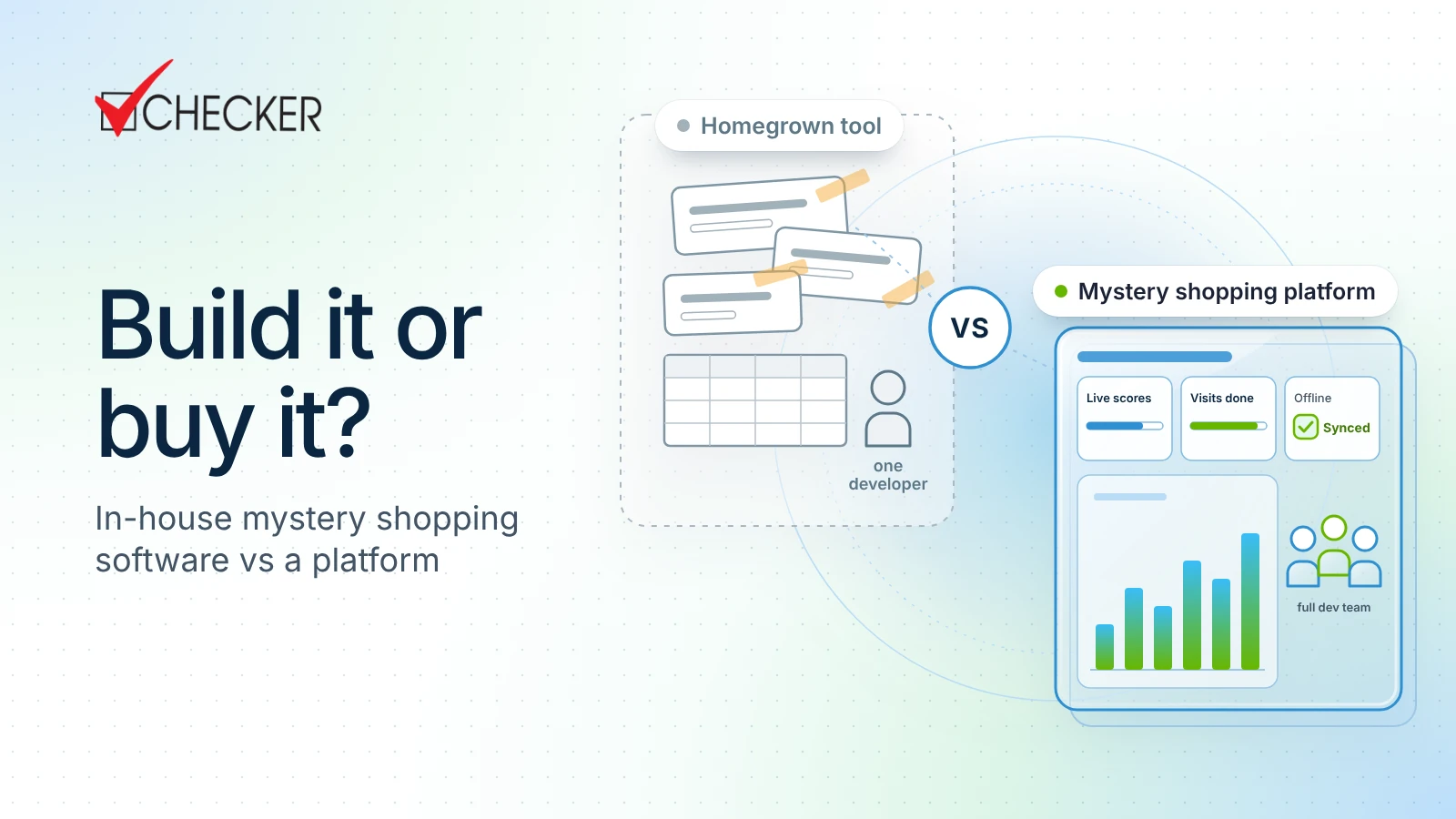
An enterprise mystery shopping platform does the same core jobs. What changes is who carries the work behind it. With your own tool, your team owns the hosting, security, updates and every new feature. With a platform, the vendor carries that load and spreads it across all its clients.
Why teams build their own mystery shopping tool
Most teams that build their own tool had good reasons at the time.
- It fits the way your team already works, because you designed it that way.
- You decide what gets built next. When a client wants a new report, you add it.
- The cost looks small. If a developer is already on the payroll, the tool feels almost free.
- Early programs are simple. A few clients in one country, with a handful of questionnaires, do not need much.
For a small program with stable needs, that logic holds for some time. Trouble usually starts later, once scale, security demands and client expectations grow faster than one or two people can keep up with.
How homegrown tools usually evolve
In our experience, in-house tools go through the same four stages. Knowing which one you are in tells you a lot about what comes next.
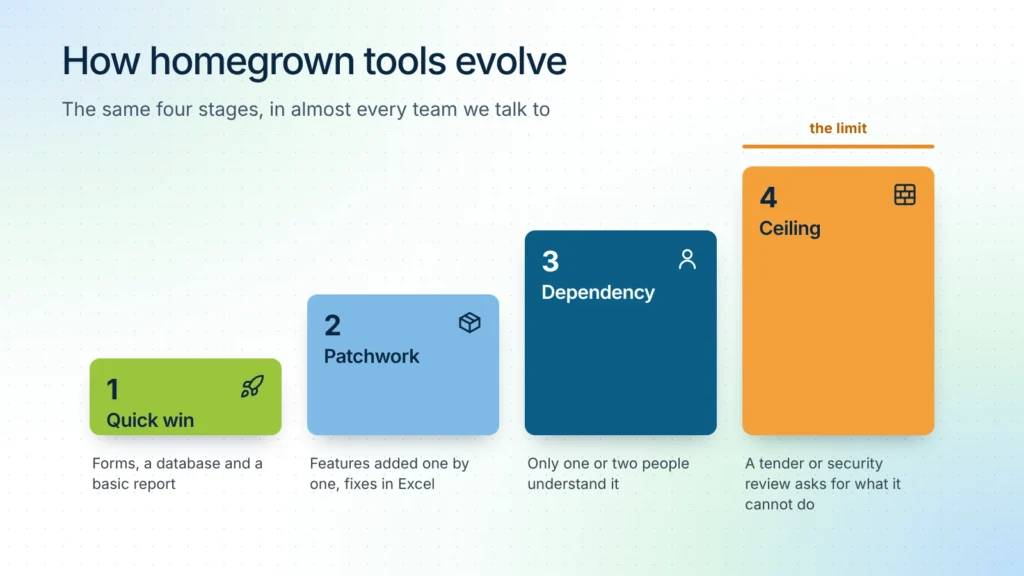
- The quick win. A developer builds forms, a database and a basic report in a few months. It works, and it costs less than any vendor quote.
- The patchwork. Clients ask for more, so features get added one by one. Exports go to Excel, where someone fixes them by hand before they reach the client.
- The dependency. The tool now runs the business, but only one or two people understand it. Changes slow down because every request goes through them.
- The ceiling. A security review, a big tender or a multi-country program asks for something the tool cannot do. At this point teams either rebuild from scratch or move to a platform.
Most teams who contact us are somewhere between stage three and four. If you are still in stage one or two, the rest of this guide is mainly about what to watch for.
Where in-house mystery shopping software starts to hurt
Homegrown tools rarely collapse overnight. Small gaps pile up until they start costing you clients and margin. The issues below come up in almost every conversation we have with teams that switch, and they get worse as programs get more complex.
The one or two developer problem
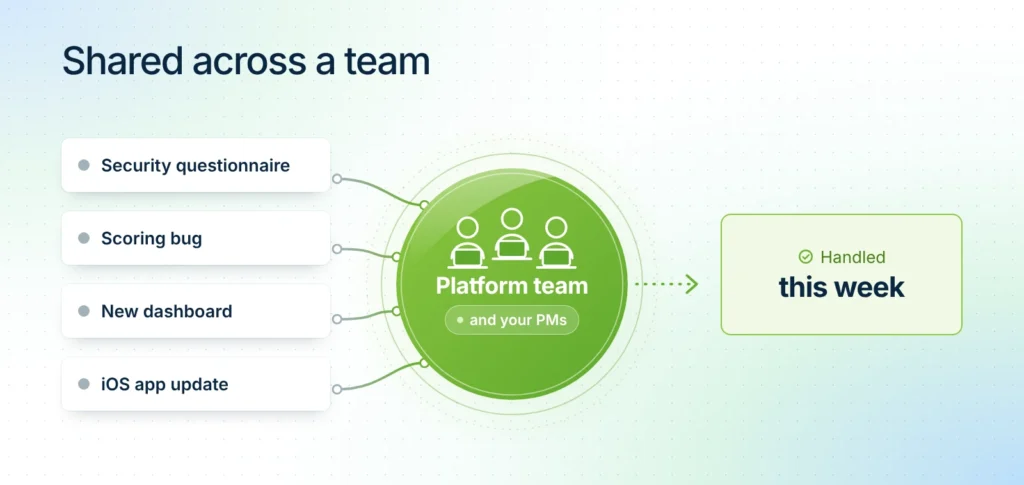
Most in-house tools depend on one or two developers who carry the knowledge in their heads. If they leave, fall ill or move to another project, your whole operation slows down.
It shows up in small ways first. A scoring bug waits two weeks because the developer is busy with something else. A client asks for a new dashboard view and hears “next quarter.” Documentation is thin, so a replacement needs months to get up to speed.
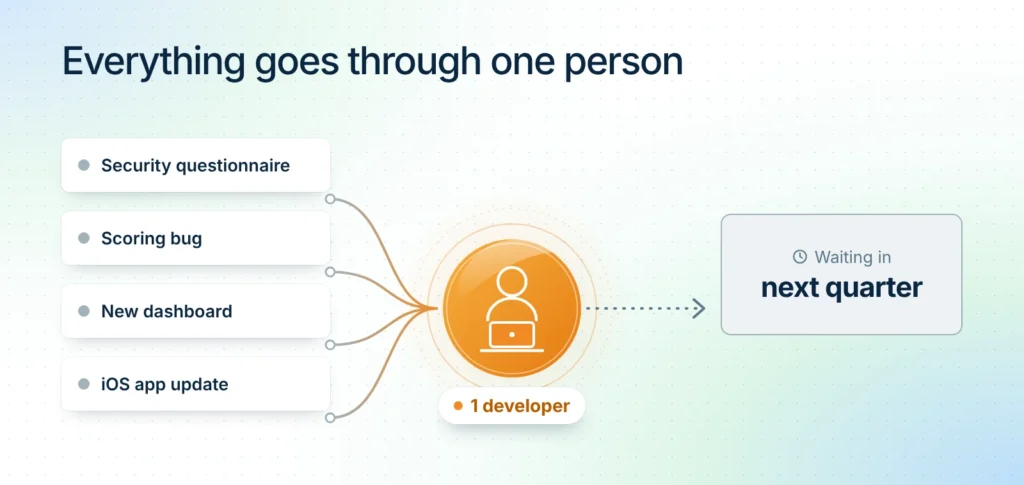
On a platform, a full development team stands behind the product. At Checker, that is our own in-house team, working on the platform every day. Your program no longer depends on one person’s calendar.
Security and data protection
Security is where homegrown tools fall behind fastest, because client expectations keep rising. Mystery shopping data often includes shopper details, staff names, photos, audio recordings and GPS locations. In Europe, that puts it under the GDPR.
The rules have teeth. Under Article 83 of the GDPR, the most serious violations can bring fines of up to €20 million or 4% of worldwide annual turnover, whichever is higher. Article 33 also requires you to report most personal data breaches to the supervisory authority within 72 hours. For a two-person team, meeting that deadline at 2 a.m. on a Sunday is hard.
Still, the fines are only part of it. Larger clients, especially banks, insurers and automotive brands, now send detailed security questionnaires before they sign. Expect questions like these:
- Is data encrypted in transit and at rest, including on shoppers’ phones?
- Do users have multi-factor authentication, and can you show who accessed what, and when?
- Where is the data hosted, and which sub-processors handle it?
- Will you sign a data processing agreement?
- How long do you keep data, and how do you delete it on request?
- When did you last restore from a backup or run a penetration test?
- What is your incident response plan, and who owns it?
With an in-house tool, someone on your team has to build, run and document every one of these controls, then keep them current. On a platform, a dedicated team handles that work across many clients.
Expected compliance and certifications
Basic security is only the starting point. Many clients now expect their suppliers to meet recognised standards, such as ISO 27001 certification, a SOC 2 report or proven GDPR compliance. These are not one-off projects. ISO 27001 needs external audits every year and full recertification every three years, and SOC 2 reports are renewed regularly to show that controls keep working over time. Keeping up means written policies, regular risk reviews, staff training, evidence for every audit and fees for outside auditors. For an in-house tool, all of that cost and effort sits with your own team, year after year.
Checker already carries that load for its clients. The platform is ISO 27001:2022 certified, SOC 2 compliant and GDPR compliant, so you can answer a client’s security questionnaire with proof instead of promises.
Keeping up with new features
Client expectations for mystery shopping software have moved quickly. Things that were rare a few years ago are now standard requests in tenders:
- AI checks that review shopper reports for quality and recode open answers automatically
- Offline data collection, so a 200-question hotel audit survives a dead Wi-Fi signal
- Live dashboards for each client and role, instead of a monthly PDF
- Automated imports via CSV, Excel, XML or API, so nobody retypes data
AI now plays a direct part in buying decisions. Research from 6sense found that about 90% of European B2B buyers said AI features were part of what they bought. Your clients buy the same way.
For an in-house team, each item on that list is its own project. A reliable offline mobile app alone can take months, and it needs updating every time Apple or Google change their operating systems. That is why most homegrown tools sit a few years behind the market, even when the team works hard.
On a platform, new features arrive with the product. Checker recently released AI-Powered QA, Ask CHECKER by Email and AI Answer Recoding, and every client got them without building anything.
Speed, quality and technical capability
A simple tool copes with a simple program. Complex operations are different. Picture thousands of visits a month across several countries and languages, with photo and audio evidence, GPS and time stamps, and dozens of clients who each need their own view.
At that scale, three things decide whether you keep the client.
Speed. How fast can you launch a program, change a questionnaire mid-wave or get results to the client? With a homegrown tool, most changes queue up for the developer. On a mature platform, project managers make those changes themselves, often the same day.
Quality. One bug in scoring logic can spoil a whole wave of results. Small in-house teams rarely have time for proper release testing, so clients end up finding the bugs. A platform tests each release across many live programs before it reaches you.
Technical depth. Mystery shopping needs more than a survey tool. A serious program usually needs most of the following, and each one is real engineering work:
- shopper recruitment, scheduling and assignment by location and profile
- proof that the visit happened, through GPS, time stamps, receipt photos or audio
- questionnaires in several languages, with logic that differs by country or channel
- penalty and bonus scoring that matches each client’s rules
- quality review before results go live, with a record of every edit
- separate client accounts and sub-accounts, each with its own dashboards
- data feeds into the client’s own systems
So the answer here is firmer. If you run complex operations and want an edge in your market, an in-house tool is usually the wrong choice. Competitors on enterprise platforms launch faster, report sooner and show clients features that would take you years to build.
It pulls focus from your core business
Building your own software means running a small software company inside your business, whether you planned to or not.
That company needs product decisions, bug triage, release planning, security reviews and support. Every hour your managers put into those tasks comes out of the work clients pay for. For agencies, that is research design, field quality and insight. For brands, it is improving the experience in their stores, branches or dealerships.
The strongest agencies and CX teams we work with treat software like accounting or payroll. It has to work perfectly, but it is not where they compete.
Why AI coding tools do not close the gap
AI coding tools make writing code much faster, but code was only ever one part of running software. Someone still has to design the system, secure it, test it, keep it running and fix it when it breaks. AI does not take that responsibility off your team.
We hear the opposite idea more and more. Companies see a developer, or even a manager, generate a working form, dashboard or scoring script in an afternoon, and conclude that an in-house team is now cheap to run. It is easy to see why.
However, a working prototype and a production system are very different things. AI-generated code brings its own problems:
- Security gaps. AI tools can produce code that runs fine but contains vulnerabilities, outdated libraries or weak access control. An experienced person still has to review every change.
- Code nobody fully understands. When large parts of a tool are generated quickly, fewer people know how it works. That makes the one or two developer problem worse.
- More to maintain. Building faster usually means building more, and every feature needs testing, updates and support for years.
- The same day-to-day load. AI will not answer a client’s security questionnaire, ship an app update when iOS changes, or restore a failed backup at midnight.
AI makes a strong engineering team faster. It does not replace one.
What in-house mystery shopping software really costs
The first build is rarely the expensive part. The real cost of in-house mystery shopping software is everything that follows, year after year. Use the worksheet below to estimate your own yearly figure. Most teams are surprised by the rows they had never counted.
| Cost item | What it includes | Often forgotten? |
|---|---|---|
| Developer time | Salaries or contractor fees for everyone who touches the tool, including part of their time | No |
| Hosting and infrastructure | Servers, storage for photos and audio, backups, monitoring | Sometimes |
| Mobile app upkeep | Updates for new iOS and Android versions, app store fees, device testing | Yes |
| Security and compliance | Penetration tests, security tools, legal review of data processing agreements | Yes |
| Manager time | Hours spent testing, reporting bugs, writing specs and handling workarounds | Yes |
| Manual data fixes | Cleaning exports, rescoring, re-entering lost data | Yes |
| Lost deals | Tenders you could not bid on because of missing features or security answers | Almost always |
| Key-person risk | The cost of hiring and onboarding if your main developer leaves | Almost always |
For agencies, these costs hit margin directly. Most programs run on a fixed fee, so every hour of rework or manual fixing comes straight out of the project margin.
In-house tool vs Checker at a glance
The table compares a typical homegrown tool with an enterprise platform like Checker. Your own tool may do better on some rows, so use it as a starting point for an internal review.
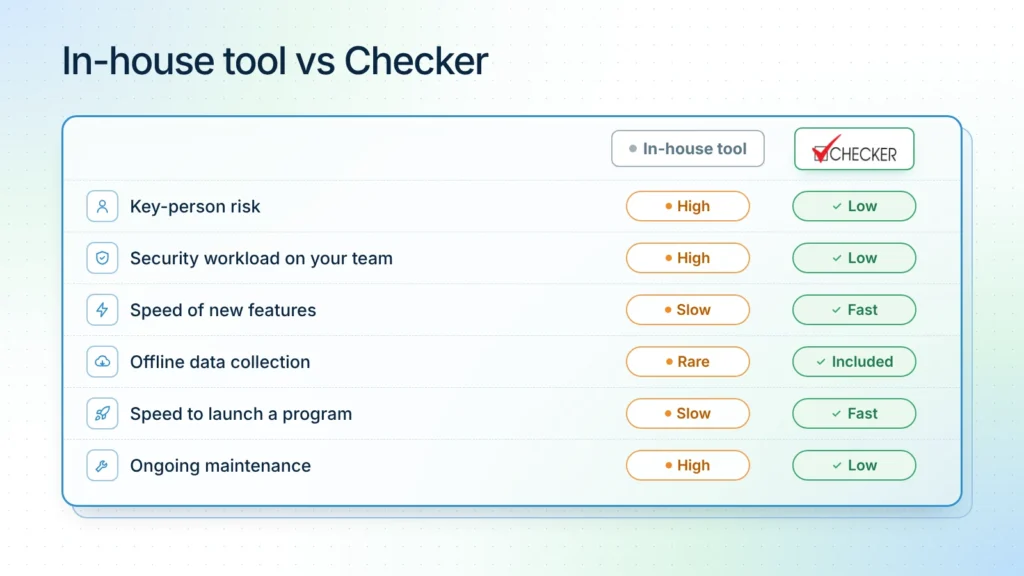
| Criteria | Typical in-house tool | Checker |
|---|---|---|
| Fit to your exact process | High | High (configurable, plus custom builds by our dev team) |
| Dependence on one or two people | High | Low (full in-house development team) |
| Security and GDPR workload on your team | High | Low (handled by the platform team) |
| Speed of new features (AI, offline, dashboards) | Slow | Continuous, included in the product |
| Offline mobile data collection | Rare, costly to build | Included (iOS and Android) |
| Real-time, role-based dashboards | Varies | Included |
| Speed to launch or change a program | Depends on developer availability | Fast, configured by your own team |
| Release testing and quality control | Often limited | Every release tested across many programs |
| Fit for complex, multi-country programs | Limited | Built for it (programs in 60 countries) |
| Focus on your core business | Split with running software | Full |
| Ongoing maintenance effort | High | Low |
| Upfront switching effort | None | Medium (one-off migration) |
Look at the last row too. Switching takes real effort, and a fair comparison has to count it.
Score your own tool in ten minutes
Rate each statement from 1 (strongly disagree) to 5 (strongly agree). Ask your operations lead and your developer to score it separately, then compare. The gaps between their answers are often the most useful part.
- More than two people could maintain our tool if our main developer left tomorrow.
- We could answer a full client security questionnaire within a week.
- Shoppers can collect data offline without losing anything.
- Clients see their own results live, without us sending files.
- We can launch a new program or change a questionnaire without waiting for a developer.
- Every release is tested before it reaches clients.
- We have shipped at least one significant new feature in the last six months.
- Our managers spend almost no time on software problems.
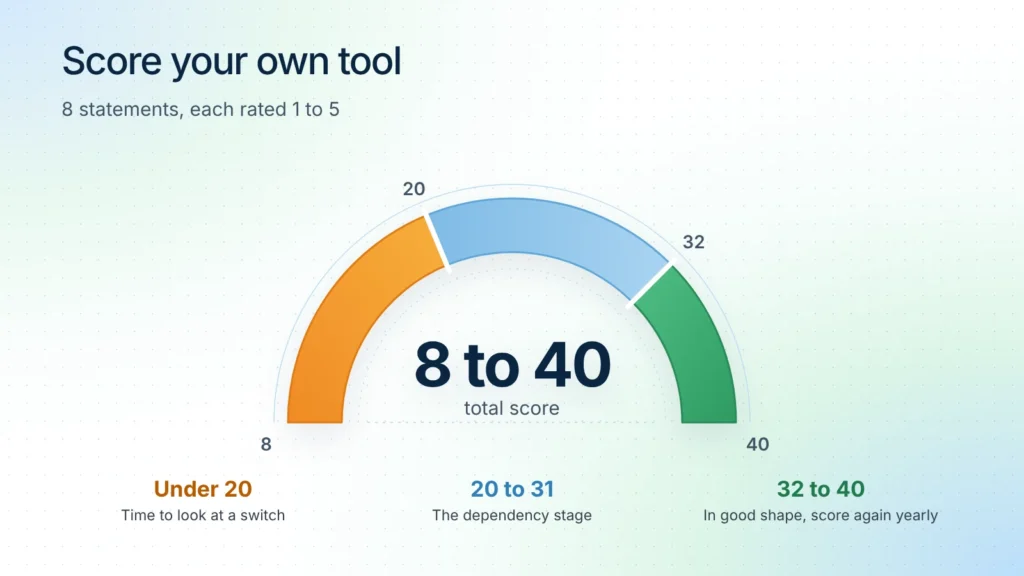
32 to 40. Your tool is in good shape. Keep it, and score it again every year.
20 to 31. You are probably in the dependency stage. Start comparing platforms before a crisis forces the decision.
Under 20. Your tool is likely costing you clients or margin already. It is worth seeing what a switch would involve.
When an in-house tool still makes sense
- Your program is small and stable, with few clients and simple questionnaires.
- You do not expect to need offline collection, AI features or advanced dashboards soon.
There is also a middle path. Some teams keep their own client portal or internal reporting and run data collection, scoring and dashboards on a platform, connected through an API. That keeps the parts that make you different and hands off the heavy engineering.
If your operations are complex, or you plan to grow, an in-house tool will hold you back a little more each year. That is the signal to start looking.
Signs it is time to switch to a mystery shopping platform
Teams usually switch after one of these moments, and often after several:
- Your key developer leaves, or you realize everything depends on them.
- A client’s security questionnaire takes weeks to answer, or you cannot answer it at all.
- A prospect asks for AI features, offline collection or live dashboards that you cannot offer.
- Your managers spend more time fixing data than analyzing it.
- You want to win larger clients or expand into new countries, and your tool is the limit.
- Maintenance eats the budget you meant for growth.
- Your managers spend more time on software decisions than on clients.
If two or more of these apply to you, it is worth seeing what a platform would change for your program.
What switching to Checker looks like
Switching is a project, but a manageable one. A typical move follows four steps.
- Review your current program. We look at your questionnaires, scoring rules, reports and client setups.
- Rebuild and configure. Your questionnaires, scoring logic and dashboards move into Checker. Where your process needs something special, our development team can build it.
- Import your history. Past data comes in via CSV, Excel, XML or API, so trend reporting continues.
- Run in parallel, then switch. Many teams run one wave on both systems before moving fully, so nothing gets lost.
Done well, the only thing your clients notice is better reporting.
Questions to ask any vendor
Whether you keep your tool or compare vendors, these questions apply to any mystery shopping software, ours included.
- Who maintains the tool, and how big is that team?
- What new features shipped in the last 12 months?
- Can you send your answers to a standard security questionnaire before we sign?
- Can shoppers work offline, and what happens to their data if the phone dies?
- How quickly can we launch a new program without your help?
- Can we bring our historical data with us, and in what formats?
- What does the full yearly cost include, and what costs extra?
Frequently asked questions
Is it cheaper to build your own mystery shopping software?
Building your own mystery shopping software can look cheaper at the start, especially if you already employ a developer. However, the ongoing cost of hosting, security, maintenance and new features usually grows every year. Compare the full yearly cost, including staff time, rather than the first build alone.
What are the biggest risks of in-house mystery shopping software?
The biggest risks are dependence on one or two developers, falling behind on security and data protection, and slow delivery of features clients now expect, such as AI checks, offline collection and live dashboards. These risks grow as your program and client list grow.
Is mystery shopping data covered by the GDPR?
Yes, when it includes personal data such as shopper details, staff names, photos, audio or locations, and the program involves people in the EU. That means you need proper access control, security and data handling, whether you build your own tool or use a platform.
How long does it take to switch from an in-house tool to Checker?
It depends on how many programs, questionnaires and years of data you move. A focused team can often migrate one program first, run a wave in parallel, and then move the rest. We give you a realistic plan after reviewing your current setup.
Can Checker match the custom features of our in-house tool?
In most cases, yes. Checker is highly configurable, and because we have our own development team, we can build custom features when a client’s process needs them. That way you keep what makes your program unique without carrying the maintenance yourself.
Can AI coding tools replace a development team for in-house software?
No. AI coding tools help developers write code faster, but they do not design, secure, test or maintain a production system. Someone still has to review the code for security, fix it when it breaks and keep it updated for years. AI makes a strong team faster, but it does not replace one.
Can we keep our historical mystery shopping data?
Yes. You can import historical data via CSV, Excel, XML or API, so your trend reports and year-on-year comparisons continue after the switch.
The bottom line
Building your own tool is often a sensible way to start. It stops making sense when your program depends on one or two developers, when security demands outgrow your team, and when clients expect features you cannot build in time. For complex operations, it also costs you speed, quality and focus, and AI coding tools do not change that.
If you are on the fence, count the cost of standing still as carefully as the cost of switching. Book a demo and bring one of your current questionnaires. We will show you how it would run in Checker, next to what you use today.