


Gyms, health clubs, boutique studios and leisure centers compete for the same customers, and most of them sell something very similar: access to equipment, classes and expertise. What makes people join, and above all what makes them stay, is the experience. That experience is created by front-desk staff, sales consultants, trainers and instructors in thousands of small moments that owners and managers rarely see. Gym mystery shopping lets you see your sales and service through a prospect’s eyes, before they sign up somewhere else.
Mystery shopping lets fitness operators see their business through the eyes of a prospective or existing member. This guide explains what to evaluate across the member journey, the different types of fitness mystery shopping, a ready-to-use checklist and scorecard, how to prepare for the New Year rush, and how to turn results into more sign-ups and fewer cancellations.
Why mystery shopping matters for gyms
Most fitness businesses depend on recurring memberships. That creates two challenges that mystery shopping speaks to directly.
Winning new members. Prospects often visit or contact several gyms before choosing. The quality of the enquiry response, the tour and the sales conversation decides where they sign up. A slow reply to a web enquiry or a rushed tour can lose a member who would have stayed for years.
Keeping existing members. Member churn is one of the biggest costs in the industry. Members leave when they feel ignored, when equipment is broken, when classes are crowded or when they do not see results. Mystery shopping checks the everyday experience that drives these decisions.
The benefits of mystery shopping for fitness businesses
- A better member experience. Shoppers identify specific moments that disappoint members, from an unfriendly greeting to a dirty changing room, so they can be fixed.
- Higher conversion of enquiries and tours. Evaluating the sales process shows where prospects are lost and which consultants need coaching.
- Better retention. Checking onboarding, class quality and facility standards addresses the reasons members cancel.
- Consistent standards across locations. Multi-site operators can compare clubs fairly and share what the best clubs do.
- A competitive edge. Shopping competitors shows how your offer, pricing and sales approach compare in the local market.
- A stronger reputation. Consistently good experiences lead to better online reviews and more referrals.
What mystery shoppers evaluate across the member journey
The most useful fitness mystery shopping programs follow the member journey from first contact to, in some cases, cancellation. Each stage has its own moments of truth.
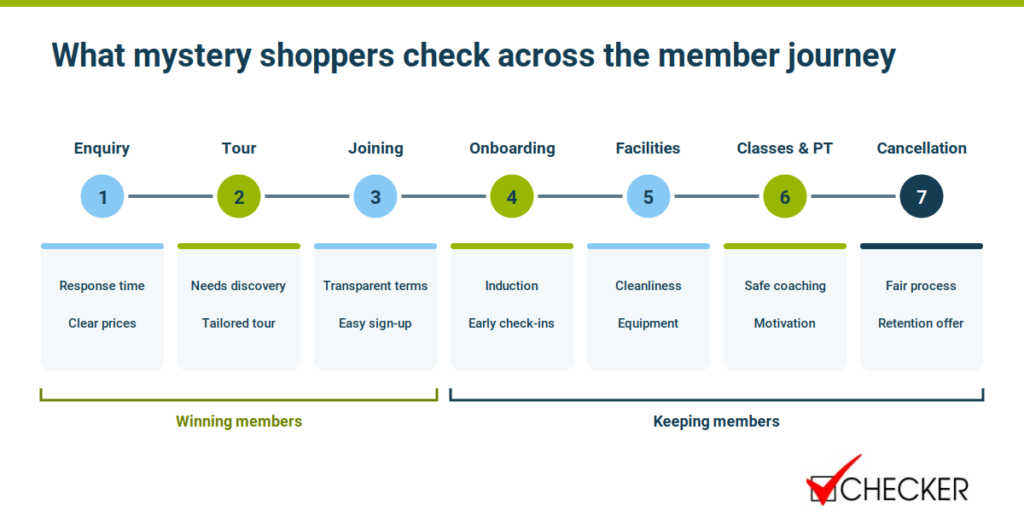
1. Enquiry
Most journeys start online or by phone. Shoppers test how quickly a web form, chat message, social media message or phone call is answered, whether the reply is personal or automated, whether prices and membership options are explained clearly, and whether a visit or free trial is offered.
2. Club tour and sales conversation
This is where most membership decisions are made. Shoppers evaluate whether they were greeted promptly, whether the consultant asked about their goals, fitness experience and schedule before presenting options, and whether the tour was tailored to those goals rather than a standard walk-through. They also note whether membership options, prices, joining fees and contract terms were explained clearly and honestly, whether objections such as price or time were handled well, and whether the consultant asked for the sale or followed up afterwards.
3. Joining and onboarding
The first weeks decide whether a new member builds a habit. Shoppers who join, or who follow a new-member scenario, check how easy sign-up was, whether an induction or fitness assessment was offered, whether equipment was explained safely, and whether staff checked in after the first visits.
4. Facilities and cleanliness
Shoppers assess the cleanliness of the gym floor, equipment, changing rooms, showers and toilets; whether equipment is working and out-of-order items are clearly marked; whether wipes, sanitizer and towels are available; and temperature, ventilation, lighting and music.
5. Classes and personal training
Shoppers attend classes or a personal training taster and evaluate whether the session started on time, whether the instructor introduced themselves, checked for injuries and new participants, gave clear and safe instructions, offered options for different levels, and created a motivating atmosphere.
6. Everyday service
On routine visits, shoppers check whether reception staff greet members, whether floor staff are visible and approachable, and how questions and complaints are handled.
7. Cancellation
The cancellation process is often overlooked, but it matters for retention, reputation and, in many countries, consumer law. Shoppers test whether the process is clear and fair, whether staff ask why the member is leaving, and whether a relevant alternative such as freezing the membership or a cheaper plan is offered without pressure.
Types of fitness mystery shopping
| Type | How it works | Best for |
|---|---|---|
| Prospect visit and tour | Shopper visits as a potential member and takes a sales tour | Sales process, first impressions, consultant coaching |
| Online and phone enquiry | Shopper contacts the club by web form, chat, social media or phone | Lead response speed and quality |
| Member experience visit | Shopper with a membership or day pass uses the facilities | Cleanliness, equipment, staff visibility, atmosphere |
| Class or PT evaluation | Shopper attends a group class or personal training taster | Instructor quality, safety, motivation |
| New member onboarding | Shopper joins and reports on the first weeks | Induction quality, early retention |
| Cancellation test | Shopper attempts to cancel or freeze a membership | Retention approach, fairness, legal compliance |
| Competitor benchmarking | Any of the above at competing gyms | Pricing, offers and sales approach in the local market |
Many operators combine a sales tour, an enquiry test and a member visit in each wave, so they see both how they win members and how they treat them once they have joined.
How to set up a fitness mystery shopping program, step by step
1. Start with a business question
Decide what you want to improve before deciding what to measure. “Why do some clubs convert half their tours and others a quarter?”, “Why are we losing members in their first three months?” and “Are all clubs meeting our cleanliness standard?” each lead to a different program. Write down two or three objectives and the decisions the results will inform.
2. Choose the visit types and channels
Match the visit types to the objectives. A conversion problem calls for enquiry tests and sales tours with follow-up tracking. A retention problem calls for onboarding scenarios, member visits and class evaluations. Most programs combine two or three types.
3. Decide how many visits, where and when
Plan enough visits per club to see patterns rather than one-off good or bad days. Multi-site operators usually cover every club in each wave, so results can be compared fairly. Spread visits across weekdays and weekends and across quiet and peak hours, including early mornings and evenings when most members train.
4. Write realistic shopper profiles and scenarios
Shoppers should match the club’s real target members in age, fitness level and motivation. A boutique cycling studio and a family leisure center attract very different customers. Give each shopper a clear brief: who they are, what they want to achieve, what concerns to raise, and what to do at the end of the visit.
5. Build the questionnaire and scoring
Use specific, observable questions and weight them by importance, as in the scorecard below. Add open questions for a short narrative of the visit, because the narrative is what managers use for coaching. Keep the form short enough that shoppers complete it carefully.
6. Recruit and brief the shoppers
Use trained shoppers who can stay in character and remember detail. Brief them on the scenario, the questionnaire, privacy rules such as no photos in changing areas, and safety: shoppers should never take part in activities beyond their fitness level.
7. Run the wave and validate every report
Shoppers complete reports straight after the visit, ideally on a mobile app with time and location check-in. Each report is then checked for completeness, consistency between scores and comments, and alignment with the brief before it reaches the client.
8. Report, act and repeat
Share results with club managers within days, compare clubs and sections, agree actions with owners and deadlines, and repeat the same scenarios in the next wave to confirm the improvement.
Fitness mystery shopping checklist
Adapt this checklist to your brand standards and the type of visit.
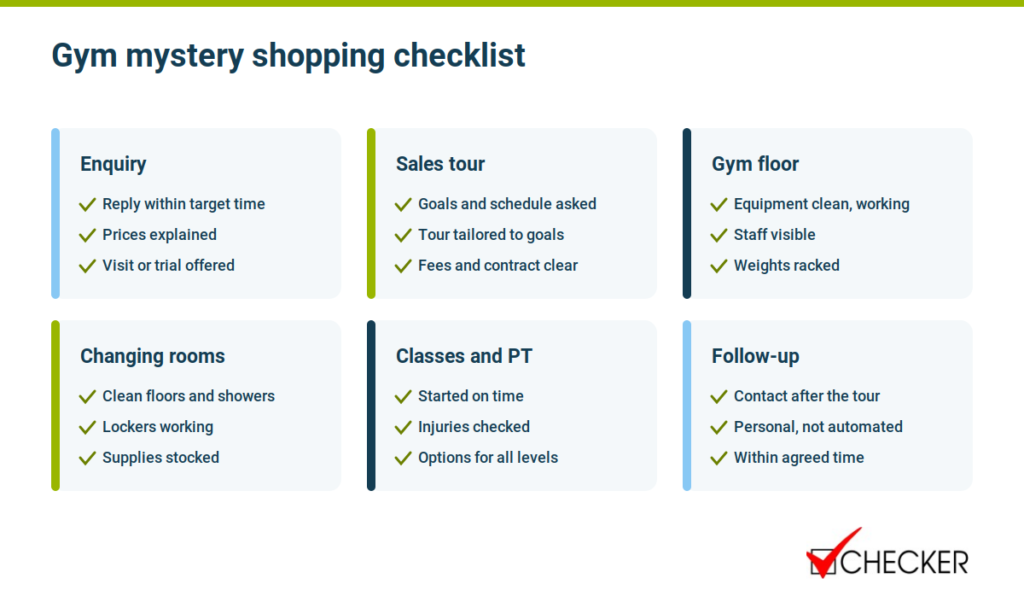
Enquiry
- Web or social media enquiry answered within [X] hours
- Phone answered within [X] rings, with club and staff name
- Membership options and prices explained clearly
- Visit, tour or free trial offered
Arrival and reception
- Entrance, signage and parking clean and clear
- Greeted within [X] seconds of reaching reception
- Staff in uniform with name badge
- Visitor or guest process smooth
Sales tour
- Consultant introduced themselves and used the shopper’s name
- Asked about goals, experience, schedule and any health considerations
- Tour tailored to the shopper’s goals
- Classes, personal training and app or digital services presented
- Prices, joining fees, contract length and cancellation terms explained clearly
- Objections handled without pressure
- Asked for the sale or proposed a clear next step
- Follow-up received within [X] days if the shopper did not join
Gym floor and equipment
- Equipment clean and in working order
- Out-of-order equipment clearly marked
- Cleaning wipes or spray available at stations
- Floor staff visible and approachable
- Free weights area tidy, weights returned to racks
Changing rooms and washrooms
- Floors, benches, showers and toilets clean
- Lockers working
- Supplies (soap, paper, hairdryers) available
Classes and personal training
- Class started on time
- Instructor introduced themselves and asked about injuries or new participants
- Clear, safe instructions with options for different levels
- Energetic, motivating atmosphere
Overall
- Temperature, ventilation, lighting and music comfortable
- Shopper would recommend the club to a friend
Sample sales tour scorecard
The sales tour is the most common fitness mystery shopping visit. A weighted scorecard keeps the focus on the behaviors that most influence sign-ups.
| Section | What is assessed | Weight |
|---|---|---|
| First impression | Greeting time, welcome, club appearance at arrival | 10% |
| Needs discovery | Questions about goals, experience, schedule, motivation | 20% |
| Tailored tour | Areas shown match the shopper’s goals; benefits explained, not just features | 20% |
| Offer and transparency | Options, prices, fees, contract and cancellation terms explained clearly | 20% |
| Objection handling | Price and commitment concerns addressed without pressure | 10% |
| Closing | Clear recommendation, asked for the sale or agreed a next step | 10% |
| Follow-up | Contact within the agreed time, personal rather than automated | 10% |
Needs discovery and transparency deserve the highest weights. A consultant who understands what a prospect wants can sell almost any membership; one who hides fees wins sign-ups that turn into complaints and cancellations.
A worked example: the January joiner
Here is a complete scenario for a fictional mid-priced gym chain, from shopper brief to result.
The shopper brief
You are Tom, 41, who has not exercised regularly for several years. Your New Year’s resolution is to lose weight and get fitter, but you are nervous about the gym and short on time because of work and family. You have already looked at a cheaper budget gym nearby. Visit on a weekday evening, ask for a tour, mention your nervousness and your limited time, and raise the price of the cheaper competitor. Do not join on the day; say you will think about it, and leave your email and phone number if asked.
What the shopper reports
- Greeting time and how the consultant introduced themselves
- Whether Tom’s goals, nervousness and schedule were explored
- Whether the tour focused on what matters to Tom, such as beginner support, short classes and quieter times
- Whether membership options, joining fee and contract terms were explained clearly
- How the price comparison with the budget gym was handled
- Whether a next step was proposed, such as a free session or induction booking
- Whether and how the club followed up in the following days
A sample result
| Section | Observation | Score |
|---|---|---|
| First impression | Greeted in under a minute, but reception was busy and cluttered | 7 / 10 |
| Needs discovery | Asked about goals; did not pick up on Tom’s nervousness or time constraints | 10 / 20 |
| Tailored tour | Standard tour of all areas; no mention of beginner classes or inductions | 8 / 20 |
| Offer and transparency | Prices clear; contract length and cancellation terms not mentioned | 12 / 20 |
| Objection handling | Explained the value of classes compared with the budget gym, without pressure | 10 / 10 |
| Closing | Offered a free trial day but did not book it | 5 / 10 |
| Follow-up | No contact in the following 5 days | 0 / 10 |
| Total | 52 / 100 |
The consultant was friendly and handled price well, yet the club probably lost Tom. The tour ignored what worried him most, and nobody followed up. Across a whole wave, a pattern like this points to two concrete fixes: training consultants to tailor tours to beginners, and setting up a follow-up process for every prospect who does not join on the day.
A second worked example: the cancellation test
The cancellation moment is the club’s last chance to keep a member, and a moment that shapes what they tell friends and write in reviews. It is also increasingly regulated: in many markets, consumer rules require cancellation to be clear and not unreasonably difficult.
The shopper brief
You are Maria, 29, a member for 14 months on a 12-month contract that now runs monthly. You want to cancel because you have started working late and rarely make it to the gym before it gets crowded. You have not been injured and you are not unhappy with the club itself. Ask at reception how to cancel. If an alternative is offered, ask how it works and what it costs, but do not accept it during the visit.
What the shopper reports
- Whether reception knew the cancellation process and explained it clearly
- Whether the notice period, final payment and any fees were stated correctly
- Whether the staff member asked why Maria wanted to leave
- Whether the alternative offered matched her reason, such as an off-peak membership or a freeze, rather than a generic discount
- Whether there was any pressure, guilt or obstruction
- Whether Maria left with written confirmation or clear next steps
- Whether the experience left her more or less likely to return in future
A sample result
| Section | Observation | Score |
|---|---|---|
| Process knowledge | Receptionist unsure; fetched the manager after a 6-minute wait | 5 / 15 |
| Accuracy of terms | Notice period stated as one month, matching the contract; final payment explained | 20 / 20 |
| Understanding the reason | Asked why Maria was leaving and listened | 15 / 15 |
| Relevant alternative | Offered 20% off the current plan; did not mention the off-peak membership that suits her schedule | 5 / 20 |
| No pressure | Polite, accepted her decision without arguing | 15 / 15 |
| Confirmation | Cancellation form completed; no written confirmation given | 5 / 10 |
| Lasting impression | Shopper would consider rejoining | 5 / 5 |
| Total | 70 / 100 |
The manager handled Maria respectfully, but the club probably lost a member it could have kept: an off-peak plan solved her actual problem, and nobody mentioned it. Across a wave, results like these show whether retention offers are matched to members’ reasons for leaving, and whether front-line staff are confident with the process.
Preparing for the New Year rush
January is the biggest month of the year for gym sign-ups, followed by a second peak in spring before summer. These periods bring the most prospects, the busiest clubs and the most pressure on staff, which is exactly when service tends to slip. A mystery shopping program built around the peak helps clubs win more of those prospects and keep them past February.
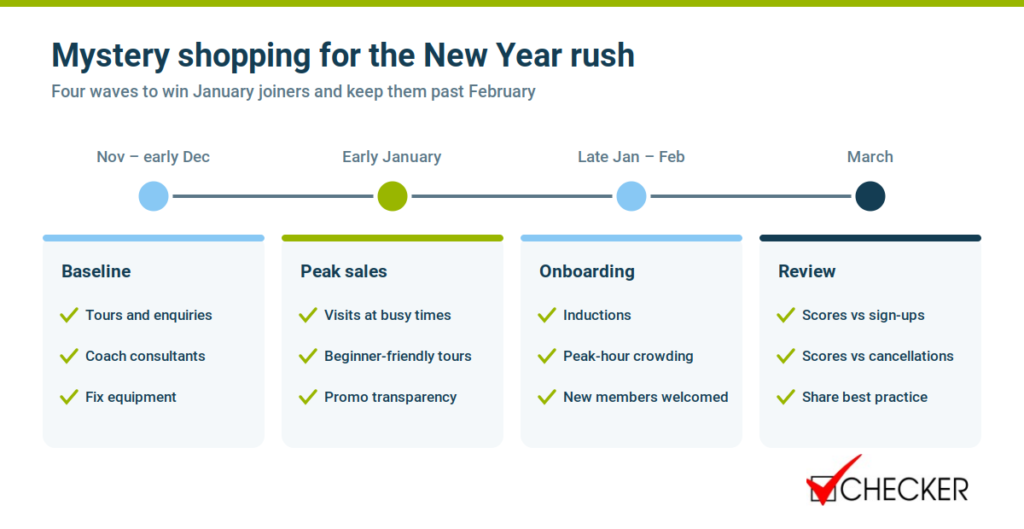
November and early December: baseline. Sales tours, enquiry tests and member visits establish how each club performs before the rush. Weak spots are fixed while there is still time: consultants are coached, follow-up processes are set up and broken equipment is repaired.
Early January: peak sales. Shoppers pose as New Year joiners at the busiest times. The focus is on greeting time when reception is crowded, how well consultants tailor the conversation to beginners, transparency on promotions and contracts, and enquiry response times when inboxes are full.
Late January and February: onboarding and first weeks. New-member scenarios check inductions, crowding in peak hours and class availability, and whether staff notice and encourage new members. This is the stage that decides whether January joiners become long-term members.
March: review. Results from all waves are compared with sign-up and cancellation figures to show which clubs converted and kept their new members best, and why.
Where to focus, by type of fitness business
Different business models win and lose members in different ways, so their mystery shopping programs should emphasize different things.
| Business type | What members expect | Where to focus mystery shopping |
|---|---|---|
| Budget and low-cost gyms | Low price, convenience, working equipment | Online joining process, equipment condition and cleanliness, staff visibility with lean staffing, crowding at peak times |
| Mid-market health clubs | Good value, classes, friendly service | Sales tours, class quality, onboarding, consistency between clubs |
| Premium and luxury clubs | Personal service, exceptional facilities, amenities | Personal recognition, attention to detail, spa and pool areas, hospitality-level service standards |
| Boutique studios (cycling, HIIT, yoga, pilates) | Community, instructor quality, experience | Instructor performance, welcome for first-timers, booking app experience, class atmosphere |
| Leisure centers and public facilities | Accessibility, affordability, family offering | Information accuracy, accessibility, swimming and family areas, booking systems |
| Personal trainers and PT studios | Results, expertise, motivation | Consultation quality, goal setting, program personalization, follow-up |
| Corporate and hotel gyms | Convenience, cleanliness, safety | Cleanliness, equipment condition, safety information |
Fitness mystery shopping metrics to track
| Metric | What it tells you |
|---|---|
| Overall and section scores by club | Where each club is strong or weak compared with the network |
| Enquiry response time | How quickly leads are contacted, by channel |
| Follow-up rate | Share of prospects who were followed up after a tour |
| Needs discovery score | Whether consultants sell to the person or recite a script |
| Price transparency rate | Share of tours where all fees and contract terms were explained |
| Facility and cleanliness score | Condition of equipment, gym floor and changing rooms |
| Class quality score | Instructor performance and safety |
| Would-recommend rate | Share of shoppers who would recommend the club |
| Score trend by wave | Whether coaching and investment are working |
The most valuable analysis links mystery shopping results to business figures. When clubs with higher needs-discovery and follow-up scores also convert more tours into memberships, the case for training is made.
Turning results into more members and fewer cancellations
Share results with clubs quickly. Club managers should see their report within days, while the visit is fresh.
Coach sales consultants with real examples. Walk through the shopper’s narrative of the tour: what the consultant said, what the shopper wanted, and what a better conversation would have sounded like.
Fix processes before people. If most clubs fail on follow-up, the answer is a better lead management process, not individual blame.
Share best practice between clubs. The highest-scoring club in each area becomes the model for the others.
Celebrate great performance. Recognize staff and instructors who receive excellent reports. Programs that only highlight failures create resistance.
Re-test after changes. Run the same scenario in the next wave to confirm the improvement.
How technology is changing fitness mystery shopping
Mobile questionnaires. Shoppers complete reports on a smartphone app straight after the visit, with timestamps and location check-in, so details are fresh and visits are verifiable.
Evidence where appropriate. Photos of public areas such as the entrance, reception and gym floor, screenshots of online enquiries and replies, and recordings of phone calls where the law allows, back up the scores.
Multichannel in one program. Visits, phone calls, online enquiries and follow-up tracking can run on one platform, so the full prospect journey appears in a single report.
AI-assisted review. AI can check reports as they arrive, flagging comments that contradict scores, missing answers or unusually short narratives, and summarizing common themes across hundreds of visits.
Live dashboards. Club managers and head office see results by club, region and question as soon as reports are approved.
In-house, agency or software: which suits your gym?
| Approach | Best for | Watch out for |
|---|---|---|
| In-house, using staff from other clubs or friends of the business | Independent gyms and small studios doing occasional checks | Visitors may be recognized; friends may be too kind; little consistency between visits |
| Specialist mystery shopping agency | Gym chains, franchise networks and multi-country operators | Choose an agency with fitness experience, trained shoppers and fast, validated reporting |
| Your own program on mystery shopping software | Operators and franchisors who want full control of scenarios and data | Requires time to recruit, schedule and manage shoppers |
For independent gyms, a small number of visits from an agency or experienced shoppers, a few times a year and including one or two local competitors, usually gives the best value.
For chains and franchise networks, consistency is the priority: the same scenarios and questionnaire in every club, every wave, with results that can be compared and shared between club managers.
Questions to ask a provider
- Have you run programs for gyms or health clubs before, and what visit types?
- How do you match shoppers to our target members?
- How do you handle privacy in changing areas and the safety of shoppers who take part in classes?
- How is each report checked before we see it?
- How quickly are results available, and can club managers see their own results in a dashboard?
- Can visits, phone and online enquiries be combined in one report?
Privacy and ethics in gyms
Gyms are personal spaces, so fitness mystery shopping needs particular care.
- No photos in changing rooms, showers or toilets, ever. Cleanliness in these areas is assessed by observation only. Photos of other areas should avoid identifiable members.
- Respect members’ privacy. Shoppers evaluate staff and facilities, not other customers.
- Be careful with health information. Shopper scenarios may mention goals or minor limitations, but shoppers should not take part in assessments or activities that could put their health at risk.
- Follow the club’s rules. Shoppers use equipment and attend classes safely, as any member would.
- Tell staff the program exists. Employees should know mystery shopping is part of quality monitoring, even if they do not know when visits happen.
- Use results for development. Programs focused on coaching rather than punishment get better results and more cooperation.
- Follow data protection rules such as the GDPR for any personal data in reports, recordings or photos.
Common mistakes in fitness mystery shopping
- Only testing the tour. The tour matters, but members leave because of the everyday experience. Include member visits and onboarding.
- Visiting only at quiet times. A club at 11 am on a Tuesday is a different place from 6 pm on a Monday in January.
- Unrealistic shopper profiles. A shopper who does not match the club’s target member will get a different conversation.
- Ignoring the follow-up. Many clubs lose prospects after a good tour simply because nobody calls back. Track it.
- Subjective questions. “Was the atmosphere good?” means different things to different people. Ask about specific, observable behaviors.
- No action plan. Results that are not discussed with club teams do not change anything.
Frequently asked questions
What is gym mystery shopping?
Gym mystery shopping is a research method in which trained shoppers visit or contact a gym, health club or studio as prospective or existing members and evaluate the experience against agreed standards, including sales, service, cleanliness, equipment and classes.
What do mystery shoppers check in a gym?
Typically: enquiry response, greeting, the sales tour, price transparency, follow-up, cleanliness of the gym floor and changing rooms, equipment condition, staff visibility, class and personal training quality, and in some programs the cancellation process.
How often should gyms do mystery shopping?
Monthly or quarterly waves suit most operators, with extra visits before and during peak periods such as January and spring.
Do mystery shoppers actually join the gym?
It depends on the scenario. Most sales tour shoppers do not join. Onboarding and member-experience scenarios use a membership, day pass or guest pass arranged by the program.
Can mystery shopping reduce member churn?
Indirectly, yes. It identifies the experiences that drive cancellations, such as poor onboarding, dirty facilities, broken equipment or indifferent staff, so they can be fixed before members leave.
Is mystery shopping useful for small, independent gyms?
Yes. Even a few visits a year give an independent owner an outside view of their club and of local competitors, which is hard to get any other way.
Can mystery shopping be used to check competitors?
Yes. Competitor visits show how other gyms present prices, promotions and contracts, and how their sales approach compares with yours.
Conclusion
In fitness, every interaction counts: the reply to an enquiry, the conversation on a tour, a clean changing room, an instructor who learns a new member’s name. Mystery shopping makes these moments visible and measurable, so gyms and health clubs can win more members, keep them longer and build a reputation as the place people want to train.
Run fitness mystery shopping with Checker. Checker helps mystery shopping agencies and fitness brands run visit, phone and online programs on one platform, from questionnaire design to AI-assisted review and live, branded dashboards.


